
Agitator Not Spinning Diagnosis Fisher & Paykel WashSmart 8.5kg
Generated by ReeFix AI · Sources: technical and specialist documentation (see Sources section)
Revision of 19/06/2026
⚠️ SAFETY WARNING / ELECTRICAL AND MECHANICAL RISK. This appliance operates with high voltage (230V). Physical intervention is highly dangerous and it is strongly recommended to entrust it to a qualified specialized technician to avoid electrocution. Also, pay maximum attention to the mechanical risk of crushing due to accidental lid drop or sudden basket start-up. ReeFix provides this diagnosis EXCLUSIVELY for educational and informational purposes.
IF the agitator does not spin but the motor activates or the machine fills with water
Probability: 40%
Most probable cause: Wear of the agitator splines or the connecting hub.
Key signs:
- The agitator appears loose, spins freely, or is wobbly when you try to move it manually.
- You hear the motor working under the tub but the agitator remains still.
- The washing machine fills with water and continues the cycle, but without agitating the laundry.
Why it happens: The plastic splines that connect the agitator to the direct drive motor shaft can wear out or 'strip' over time, especially with heavy loads. The motor works correctly, but the mechanical force is not transferred to the agitator.
Quick check (only with machine off and unplugged!):
- Unplug the washing machine from the electrical outlet.
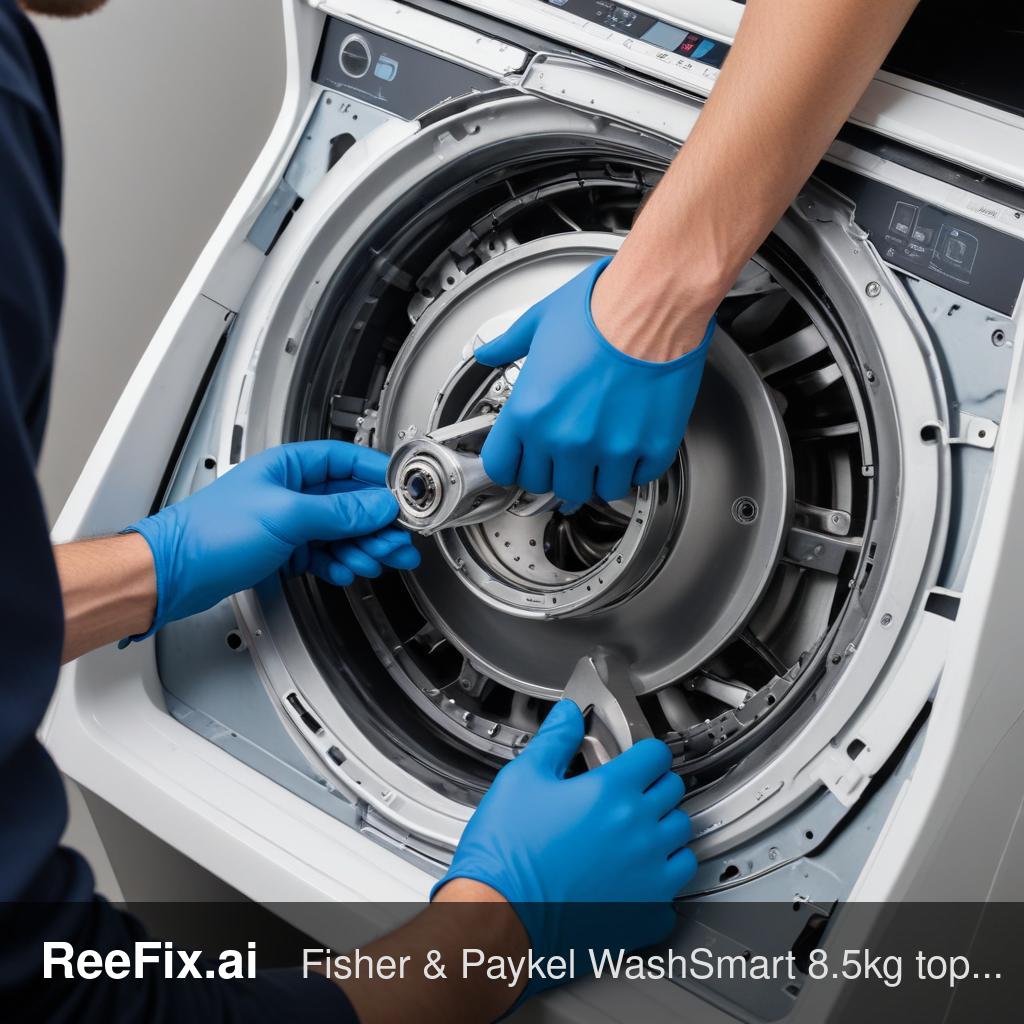
- Remove the agitator (usually by unscrewing the central cap and the retaining bolt underneath, then pulling upwards).
- Visually inspect the bottom of the agitator and the shaft for obvious signs of 'stripped' or smooth plastic.
Costs and decision: The Fisher & Paykel WashSmart 8.5kg agitator drive block (hub/insert) is an inexpensive spare part, and replacement is feasible for a user with good manual skills. It requires a Screwdriver set and a socket wrench.
IF the machine does not start the agitation cycle and the "lid locked" light flashes
Probability: 30%
Probable cause: Faulty lid switch/lock.
Key signs:
- The machine fills with water but stops before agitation.
- The "Lid Locked" light flashes or does not illuminate steadily, even if the lid is physically closed.
Why it happens: The lid switch is a fundamental safety device. If the electronic board does not receive the signal that the lid is closed and securely locked, it inhibits the motor from starting for agitation and spinning.
Check (only with machine off and unplugged!):
- Unplug the washing machine.
- Inspect the locking pin on the lid to ensure it is not broken.
- A technician will check the electrical continuity of the lock with a multimeter.
Costs and decision: Replacing the lid lock is a medium-low cost intervention. It is a relatively simple operation, but requires care not to damage the console plastics.
IF the agitator moves in jerks, makes abnormal noises, or the motor does not start at all
Probability: 20%
Probable causes: Faulty Rotor Position Sensor (RPS) or problems with the Stator/Rotor assembly (SmartDrive).
Key signs:
- The agitator tries to move but does so with violent jerks, or stops completely.
- Total absence of movement and abnormal noises (clunking) coming from the motor under the tub.
Why it happens: Fisher & Paykel washing machines use SmartDrive direct drive technology (without belts or capacitors). The motor consists of a fixed Stator and a magnetic Rotor. The RPS Sensor reads the rotor's position; if it fails or gets wet, the board doesn't know how to drive the motor, causing jerky movements or a complete stop.
Checks (require technician):
- A technician will need to lift the machine and inspect the SmartDrive motor.
- They will test the RPS sensor (a very frequent cause) and check the integrity of the stator windings.
Costs and decision: The RPS sensor is a medium-low cost spare part. If the damage involves the entire direct drive motor assembly (often commercially searched as Fisher & Paykel WashSmart 8.5kg washing machine transmission), the cost increases and requires professional intervention.
IF there are no noises, the agitator is firm, and the lid locks regularly
Probability: 10%
Probable causes: Motor Control Module (MCM) or Faulty Main Board.
Key signs:
- Lack of any sign of life from the motor, despite water being loaded correctly.
- Erratic behavior of the control panel.
Why it happens: The electronic board (MCM) is the "brain" that sends current to the SmartDrive motor. A short circuit, a power surge, or wear of electronic components can burn out the motor drivers on the board.
Checks (require technician):
- Advanced electronic diagnosis to check the output voltages from the board to the stator.
Costs and decision: Replacing the electronic module is the most expensive intervention and requires a specialized technician for correct configuration.
THEN:
Quick checks for the user (with machine unplugged):
- Loose agitator? Try to rotate and lift the agitator. If it spins freely without magnetic resistance, the splines are worn. You can attempt to replace the Fisher & Paykel WashSmart 8.5kg agitator drive block (hub) yourself.
- "Lid locked" light flashing? Check that the lid pin is intact. If it is, the problem lies with the safety switch, whose replacement is low cost.
Output for technician: The agitator not spinning fault on a SmartDrive system requires targeted investigation. Start with a mechanical inspection of the agitator splines. Subsequently, check the lid lock. If the mechanics and safety features are intact, lift the machine and test the Rotor Position Sensor (RPS), a primary cause of jerky movements or failed starts. Finally, check the stator windings. If these checks are negative, the diagnosis shifts towards the Fisher & Paykel WashSmart 8.5kg main control board.
Why is my Fisher & Paykel WashSmart 8.5kg agitator not spinning but the motor runs?
Likely due to worn agitator splines or a damaged connecting hub. The motor works, but power isn't transferred to the agitator.
How can I tell if my washing machine agitator splines are worn?
Key signs include a loose or wobbly agitator, hearing the motor but no agitation, and the machine filling without laundry movement.
Is it safe to diagnose a non-spinning washing machine agitator myself?
No, due to high voltage and mechanical risks. It's strongly recommended to contact a qualified technician for safe and accurate diagnosis.
This diagnostic report is generated using an artificial intelligence system (RAG) based on the aggregation of online data. The moderation by Luca Chia (Electronic Expert) validates its logical coherence and technical plausibility regarding the described symptoms, confirming the correctness of the AI's diagnostic reasoning, without however constituting an absolute guarantee of resolution for individual cases.