
Beko BDIN38531D Dishwasher Salt Not Dissolving: Diagnosis Guide
Generated by ReeFix AI · Sources: technical and specialist documentation (see Sources section)
Revision of 16/06/2026
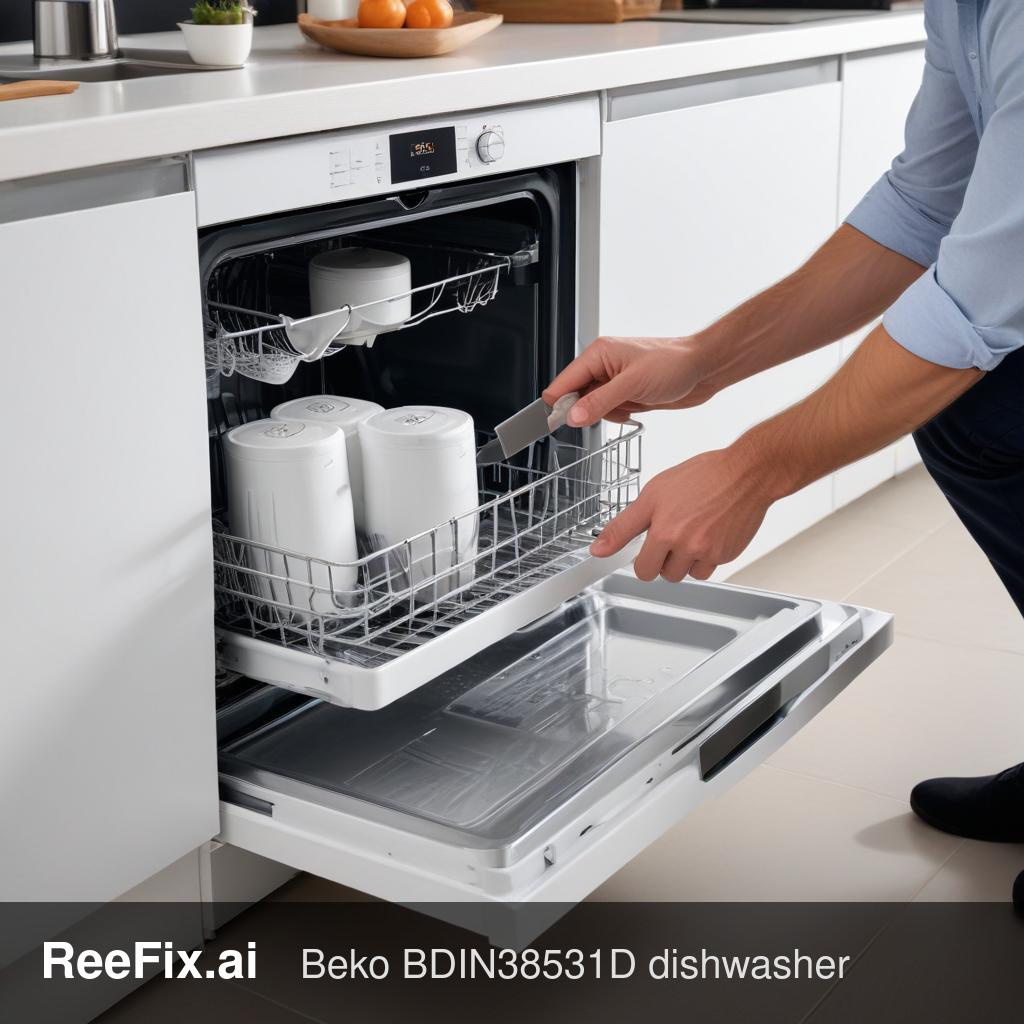
WARNING: Electrical and mechanical risk. This dishwasher operates at 230V. Before any intervention, unplug the appliance or switch off the main circuit breaker on the electrical panel. If removing panels or working on the door, be extremely careful of sharp metal edges and the potential sudden snap of hinge springs. ReeFix provides this diagnosis EXCLUSIVELY for educational and informational purposes. Intervention on internal components must be performed by a qualified technician.
HIGH PRIORITY
Problem: The salt in your Beko BDIN38531D dishwasher is not dissolving, an anomaly often indicated by the salt indicator light remaining constantly on the control panel despite the reservoir being full. The most common cause (60-75% probability) is a physical obstruction or a problem with the salt itself.
Causes and Probabilities:
- Salt bridge or agglomerated salt (50-60%): Humidity and wash cycles have caused the formation of a solid, compact mass inside the reservoir, preventing water from circulating and the salt from dissolving. This is a very common issue.
- Why: Hygroscopic salt, if not stirred or if of suboptimal quality, solidifies, creating a real "plug" that blocks the brine from reaching the resins.
- Defective dispenser cap or gasket (10-15%): A poorly closed, stripped, or worn gasket allows wash water (full of detergent) to enter the salt reservoir uncontrollably.
- Why: The entry of soapy water contaminates the reservoir, leads to abnormal salt agglomeration, and compromises the resin regeneration process.
- Incorrect type of salt (5-10%): Using fine table salt instead of coarse dishwasher-specific salt creates a dense sludge that irrevocably obstructs the system.
- Why: Fine salt dissolves too quickly and compacts at the bottom, blocking the softener's hydraulic passages.
Quick checks (DIY):
- Unplug the dishwasher from the electrical outlet.
- Unscrew and remove the salt dispenser cap located at the bottom of the tub.
- With the handle of a wooden spoon (never use metal or sharp objects), try to gently stir the salt to break up any hardened blocks. If the salt is a single block, pour some warm (not boiling) water into the reservoir, let it sit for 10-15 minutes, and try to break it up again.
- Check the cap and the O-ring (the rubber gasket). Look for cracks, deformations, or cuts. Make sure it screws on tightly without spinning freely.
- Make sure to use only Dishwasher Salt of coarse grain and high quality.
Costs:
- Agglomerated salt: 0 € (resolvable manually with warm water)
- If damaged, you will need to purchase a replacement Beko BDIN38531D Dishwasher Salt Dispenser Cap: 10-30 €
- Supply of correct salt: 5-15 €
MEDIUM PRIORITY
Problem: If you have dissolved the salt block and checked the cap, but the light remains on and dishes show white streaks (limescale), the problem lies in the electromechanical components of the water softener.
Causes and Probabilities:
- Defective regeneration solenoid valve (15-20%): This solenoid valve, mounted directly on the softener block, opens to allow water to flow into the salt reservoir and create brine. If it is burnt out or blocked, water never reaches the salt.
- Why: The solenoid valve coil can electrically break, or the internal plunger can get stuck due to limescale buildup.
- Internal obstruction in the softener ducts (5-10%): Residues of hardened salt or impurities may have blocked the thin internal passages connecting the salt reservoir to the ion-exchange resins.
- Why: Prolonged accumulation of minerals narrows the hydraulic channels, preventing the flow of the saline solution.
Key signs/indicators:
- The salt in the reservoir is loose and coarse-grained, but the level never drops, even after dozens of washes.
- Dishes come out dull and with obvious limescale spots.
Tools needed (for technician or advanced user):
- Multimeter: to check the continuity (Ohm) of the solenoid valve coil.
- Screwdriver set (Torx, Phillips): to remove side panels and plinth.
- Tongue-and-groove pliers: to loosen hose clamps.
Output for technician: The customer has already verified the absence of salt bridges and the integrity of the cap. Instrumental verification of the Beko BDIN38531D Dishwasher Water Softener Solenoid Valve (coil continuity check) and inspection of the side hydraulic labyrinth are required to rule out obstructions towards the resin block.
Costs:
- Beko regeneration solenoid valve: 40-80 € (replacement part)
- Technician labor: 80-150 € (for panel removal, diagnosis, and replacement)
- Estimated total cost: 120-230 €
LOW PRIORITY
Problem: These causes are rare but involve invasive and costly interventions concerning the hydraulic or electronic core of the machine.
Causes and Probabilities:
- Irreversible failure of the softener unit (under 5%): The resin block might be saturated, contaminated by detergent (due to an open cap), or internally damaged.
- Why: If the ion-exchange resins lose their effectiveness or become compacted, the entire softener block becomes unusable and is not repairable, only replaceable as a whole.
- Defective salt level sensor (Reed Switch) (under 5%): A small magnetic sensor detects the position of a float inside the salt reservoir. If it fails, the board doesn't know if there's salt or not.
- Why: The reed contact can stick or the internal float can get blocked due to dirt, sending incorrect signals to the motherboard.
- Problems with the main control board or wiring (<2%): The electronic board does not send 230V to the regeneration solenoid valve at the appropriate time in the cycle.
- Why: A burnt relay on the motherboard or a severed wire in the door hinge prevents the descaling system from activating.
Counter-examples:
- If the salt light turns off when you fill the reservoir, the level sensor (Reed Switch) is working perfectly.
- If the solenoid valve receives voltage (verifiable with a multimeter during the regeneration phase) but does not activate, the problem is the valve, not the motherboard.
Safety notes: Replacing the entire softener block requires tilting the dishwasher and disassembling the base. It is a complex operation that carries risks of water leaks and structural damage if not performed correctly.
Prevention tips: Always use the provided funnel to load salt, avoiding dropping granules onto the bottom of the tub (which causes rust). Always clean the edges of the thread before closing the cap to ensure a perfect watertight seal.
Costs:
- Complete softener unit: 100-200 € (replacement part)
- Salt level sensor: 20-50 € (replacement part)
- Main control board: 150-300 € (replacement part)
- Technician labor: 80-200 €
- Estimated total cost: 150-500+ €. At these spending levels, repair becomes uneconomical.
Operational Decision: Always start with zero-cost checks: stir hardened salt with a wooden spoon and ensure the cap closes properly (cost 0-30€). If the problem persists and dishes remain dull, a fault in the regeneration solenoid valve is likely: contact a technician for diagnosis (estimated cost 120-230€, repair recommended). If, however, the technician finds that the entire softener block is contaminated or the motherboard is burnt out (cost 150-500+€), we recommend considering replacing the entire dishwasher, especially if it is more than 5-7 years old.
Why is my Beko BDIN38531D dishwasher salt not dissolving?
The most common cause (50-60%) is a salt bridge or agglomerated salt blocking water circulation. A faulty dispenser cap/gasket is also possible.
How can I diagnose why my dishwasher's salt indicator stays on?
If the reservoir is full, check for a solid salt mass (salt bridge). Also, inspect the dispenser cap and gasket for damage or improper sealing.
When should I call a technician for a dishwasher salt dissolving issue?
If you suspect a faulty dispenser cap/gasket or cannot resolve a salt bridge, a qualified technician is recommended due to electrical and mechanical risks.
This diagnostic report is generated using an artificial intelligence system (RAG) based on the aggregation of online data. The moderation by Luca Chia (Electronic Expert) validates its logical coherence and technical plausibility regarding the described symptoms, confirming the correctness of the AI's diagnostic reasoning, without however constituting an absolute guarantee of resolution for individual cases.