
Bertazzoni F6011MODPLC Oven Door Lock Stuck - Diagnosis Guide
Generated by ReeFix AI · Sources: technical and specialist documentation (see Sources section)
Revision of 20/06/2026
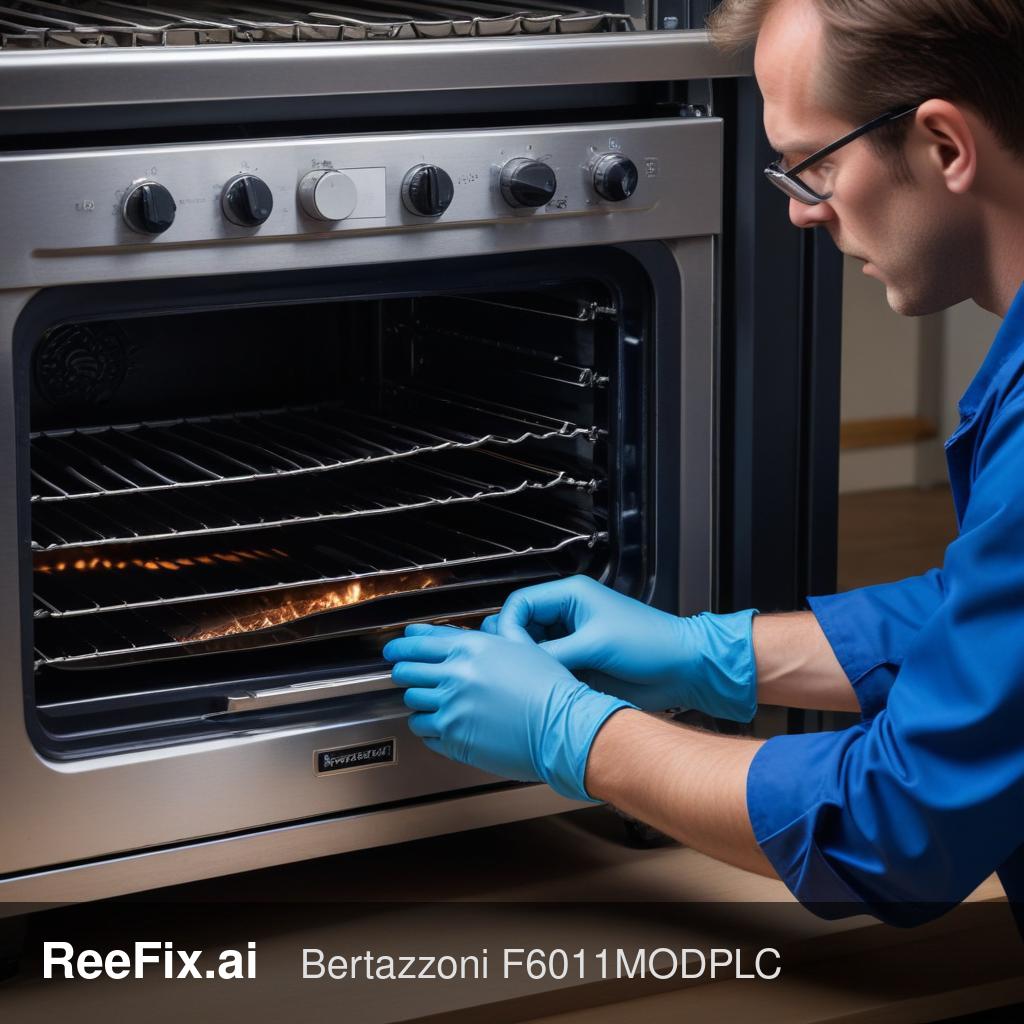
⚠️ SAFETY WARNING / ELECTRICAL AND MECHANICAL RISK. This oven operates with a 230V mains voltage. Before any physical intervention, it is essential to disconnect the appliance by acting on the main circuit breaker or by unplugging the power cord. Furthermore, if working on the door, pay utmost attention to the mechanical risk due to the sudden snap of the powerful hinge springs. Physical intervention can be dangerous, and it is recommended to entrust it to a specialized technician. ReeFix provides this diagnosis for informational purposes only.
TYPICAL ERROR
The Bertazzoni F6011MODPLC oven door remained locked after a pyrolytic cleaning cycle, even once the appliance is completely cold. This is a common problem that prevents oven use and indicates an anomaly in the locking mechanism or control system.
The most probable causes are:
- Mechanical blockage or misalignment (45%): The extreme heat of pyrolysis (up to 480°C) can cause slight expansion or deformation of the metal components of the lock or door. Even when the oven is cold, the latch might remain stuck in its housing, preventing the actuator motor from unlocking it.
- Key signs: The door is firmly locked, no noise is heard from the unlock motor when attempting to open or reset the oven.
- Defective or miscalibrated temperature sensor (NTC/PT1000) (25%): The sensor that monitors the oven's internal temperature might send incorrect readings to the control board, making it "believe" that the oven is still too hot. For safety, the board would keep the door locked.
- Key signs: The oven is cold to the touch, but the door does not unlock, and the LCD display shows no indications of unlocking.
- Damaged lock microswitch or actuator motor (20%): The small switches (microswitches) within the locking mechanism verify the latch's position. If damaged by heat or wear, they do not communicate correctly with the board. The actuator motor can also fail (e.g., broken gears, burnt coil).
- Key signs: A slight click or hum is heard from the lock area when attempting to unlock, but the latch does not move. The LCD display might signal a generic anomaly or a persistent door lock indication.
- Control board (PCB) failure or faulty relay (Low probability): In rare cases, a relay on the board that controls the unlock motor might weld or not function correctly. A software lock on the board can also prevent unlocking.
- Key signs: No signal from the motor, no error indication on the LCD display, all other components seem to be working.
It often happens that after a very intense and prolonged pyrolysis cycle, mechanical tolerances are reduced, making unlocking difficult even when the oven is cold. A bump or violent closing of the door over time can worsen the misalignment, making the mechanism more vulnerable to jamming.
HOW TO FIX
Quick checks you can do yourself (cost: 0 €):
- Electrical Reset: Completely unplug the oven from the electrical outlet or turn off the dedicated circuit breaker for at least 5-10 minutes. Reconnect and try to turn on the oven, then turn it off and check if the door unlocks. This can resolve temporary software blocks.
- Complete Cooling: Make sure the oven is actually cold to the touch. Sometimes, even if it seems cold, the sensor might still detect a temperature just above the safety threshold.
- Short Cooking Cycle: If possible, start a short cooking cycle (e.g., 10-15 minutes at low temperature, not pyrolysis) and then cancel it manually. Sometimes this can "wake up" the locking mechanism.
Intervention for a specialized technician (or experienced user with tools and risk awareness):
For more complex causes, a more in-depth intervention is required. Always remember to disconnect the appliance by acting on the main circuit breaker before any physical intervention.
- Access to Components: It will be necessary to remove the oven from its cabinet and remove the top or rear panels to access the locking mechanism, temperature sensor, and control board.
- Necessary tools: Torx Screwdriver Set, Insulated Hand Tools.
- Mechanical Check: Inspect the locking mechanism. Attempt to manually unlock the latch (if accessible) to check if it is physically stuck or if the actuator motor gears are damaged. Check the alignment of the latch with its housing.
- Potential replacement part: Bertazzoni F6011MODPLC Oven Door Lock Actuator (estimated cost: 70-150 €).
- Temperature Sensor Test: Use a Digital Multimeter to measure the resistance of the Oven Temperature Sensor Probe PT1000/NTC at room temperature. Compare the value with the manufacturer's specifications. An out-of-range value indicates a defective sensor.
- Potential replacement part: Oven Temperature Sensor Probe PT1000/NTC (estimated cost: 30-70 €).
- Microswitch and Actuator Test: Check the continuity of the door lock microswitches with the multimeter in different positions (door closed/open, latch locked/unlocked). If the actuator motor is accessible, you can check if it receives voltage from the control board when it should activate. Also check the Oven Thermal Safety Limiter Thermostat for continuity.
- Potential replacement part: Microswitch (estimated cost: 15-30 €), Oven Thermal Safety Limiter Thermostat (estimated cost: 15-40 €).
- Control Board Inspection: Examine the board for signs of damage, burns, broken traces, or faulty relays.
FINAL CHECK
To decide in 60 seconds:
- If the electrical reset or short cycle resolves the problem: The cause was likely a temporary software block. You can continue using the oven. Cost: 0 €. Repair yourself.
- If the problem persists and you don't feel confident disassembling the oven or don't have the tools: Contact a specialized technician. The cost of the call-out and diagnosis is typically 80-150 €, plus the cost of the replacement part (30-150 € for a sensor or actuator) and any additional labor. Contact a technician.
- If a technician diagnoses a fault with the actuator motor or sensor: Repair is often cost-effective, with a total cost (parts + labor) between 150-300 €. Repair yourself or contact a technician.
- If the technician diagnoses a fault with the control board (PCB) or multiple components simultaneously: The cost of the replacement board can exceed 150-300 € (plus labor). If the oven is old, or the total repair cost exceeds 50-60% of the value of a new equivalent appliance, it might be more sensible to consider replacement. Replace the device.
Why is my Bertazzoni F6011MODPLC oven door stuck locked after pyrolysis?
Likely mechanical blockage (45%) or a faulty temperature sensor (25%). No motor noise suggests mechanical; incorrect readings point to sensor.
What are common reasons an oven door won't unlock after a self-clean cycle?
High heat can cause mechanical parts to warp or stick, or a temperature sensor might incorrectly signal the oven is still hot.
Is it safe to try and fix a stuck oven door lock myself?
No, due to 230V electrical and powerful hinge spring risks. It's strongly recommended to consult a specialized technician for diagnosis and repair.
This diagnostic report is generated using an artificial intelligence system (RAG) based on the aggregation of online data. The moderation by Luca Chia (Electronic Expert) validates its logical coherence and technical plausibility regarding the described symptoms, confirming the correctness of the AI's diagnostic reasoning, without however constituting an absolute guarantee of resolution for individual cases.