
Blueair Blue Pure 211+ Loud Noise and Fan Error Diagnosis
Validated by Luca Chia, Certified Electronic Technician
Revision of 17/06/2026
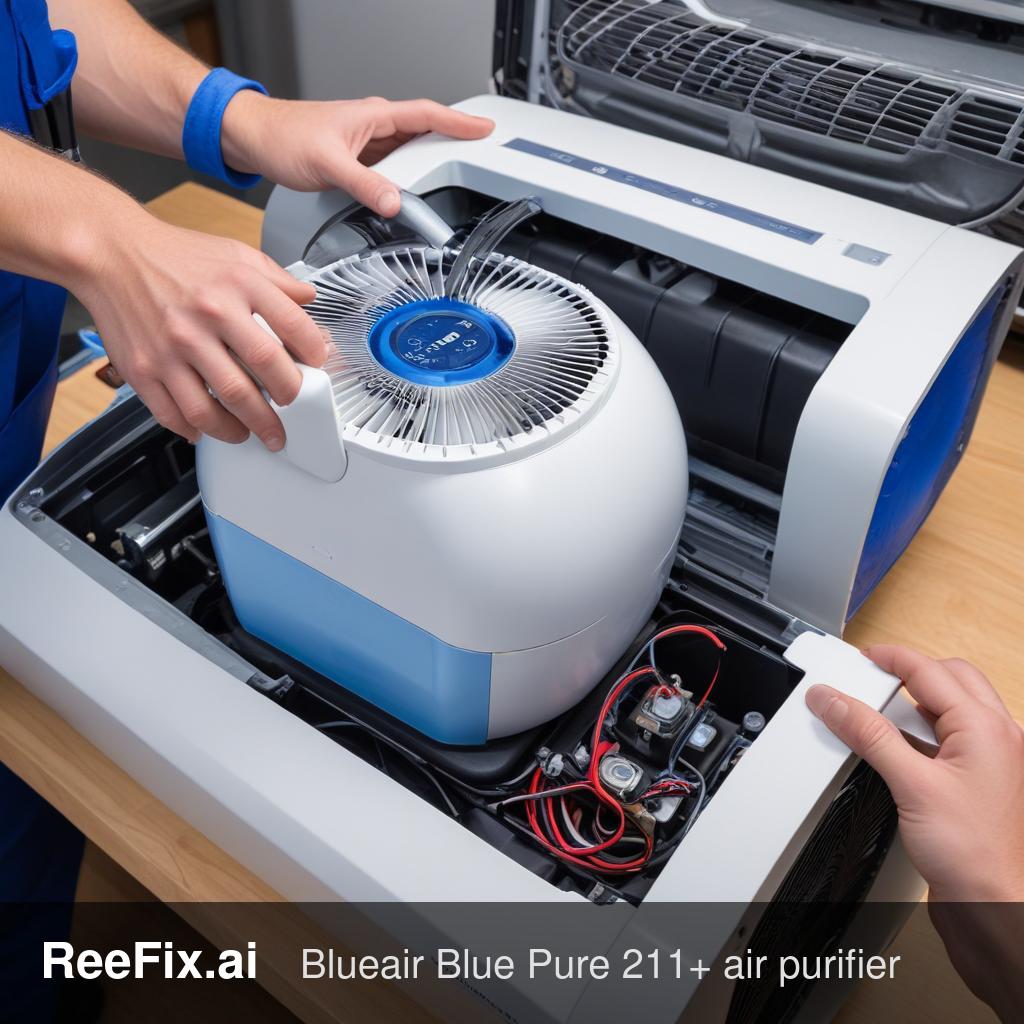
⚠️ SAFETY WARNING. This appliance is connected to the mains electricity. It is mandatory to always unplug it before any disassembly. If the physical intervention is complex, it is recommended to rely on a qualified technician for your safety. ReeFix provides this diagnosis EXCLUSIVELY for educational and informational purposes.
QUICK TEST
Your Blueair Blue Pure 211+ air purifier is making a loud noise, vibrating, and indicating a fan anomaly or blockage. The goal is to quickly understand the most probable cause to decide on a course of action.
- Unplug the appliance from the power. This is the first and most important precaution.
- External inspection: Remove the fabric pre-filter and the main block filter. Check the upper fan area and the blades through the grilles. Look for dust accumulation, pet hair, or foreign objects stuck. Sometimes, a small object accidentally fallen inside can make a lot of noise.
- Manual fan test: With the appliance unplugged, try to gently spin the fan blades by hand.
- Does it spin freely and silently? This reduces the likelihood of a mechanical blockage or severely worn bearings.
- Do you feel resistance, a rubbing noise, or excessive play? This is a strong indicator of worn bearings or an object preventing rotation.
- Are the blades bent or damaged? Even a slight deformation can cause imbalance and strong vibrations.
- Summary cleaning: Use a can of compressed air to remove visible dust and debris from the blades and fan housing. Sometimes, an asymmetrical accumulation of dust on the blades can create enough imbalance to cause noise and vibrations.
DECISION FORK
Based on the results of your quick test, here are the probabilities and recommended actions:
Scenario A: Fan blocked or with resistance / Damaged blades (Probability 35-45%)
- Key signs: During the manual test, the fan does not spin freely, you hear rubbing, metallic noises, or you notice bent/damaged blades or obvious foreign objects.
- Most probable cause: Foreign objects (35%) or worn motor bearings (45%).
- Decision:
- Repair yourself (with caution): If you found an easily removable foreign object and, after cleaning, the fan spins freely and silently, you can try to reassemble and test. If the blades are damaged or the bearings are noisy/resistant, the repair is more complex.
- Contact a technician: If the fan is blocked or noisy even after removing visible objects, or if the blades are bent, it is necessary to disassemble the upper part of the unit to access the Blueair Blue Pure 211+ fan assembly or the replacement motor. This requires tools such as a precision screwdriver set and disassembly knowledge. Worn bearings are the most common cause of persistent noise and require replacing the motor or the entire block.
- Replace the device: If the estimated cost for replacing the fan assembly or motor (which can range between 50-100€ for the part plus labor) approaches or exceeds 50% of the cost of a new Blueair Blue Pure 211+, replacing the entire purifier is often the most logical option, especially if the appliance is out of warranty and old.
Scenario B: Fan spins freely and silently / No damage (Probability 15-20%)
- Key signs: After cleaning and manual testing, the fan seems fine, but the blockage persists or the noise/vibration reappears as soon as the device is turned on.
- Most probable cause: Electrical fault in the motor or control circuit (15%), or loose mounting screws/degraded dampers (5%).
- Decision:
- Contact a technician: An electrical problem requires diagnosis with a multimeter and specific knowledge to check the power supply to the motor or components on the control board. Attempting to repair electronics yourself without experience can be dangerous. A technician can also check for loose screws or worn anti-vibration mounts.
- Replace the device: Main electronic board failures are often expensive to diagnose and repair, making the purchase of a new purifier the more economically advantageous alternative.
CONFIRMED DIAGNOSIS
Your Blueair Blue Pure 211+ has a ventilation system fault, manifested by abnormal noise and vibrations, culminating in system blockage.
- Worn Motor Bearings (45%): This is the most frequent cause. The fan motor bearings, with prolonged use, can lose lubrication or degrade, generating friction noises, hums, and vibrations. The noise tends to worsen with increasing fan speed. This often happens in appliances that operate continuously for many hours a day.
- Foreign Objects or Blade Imbalance (35%): Accumulations of dust, hair, or small objects fallen from the upper grille can get stuck between the blades or in the housing, causing rubbing noises and strong vibrations due to rotational imbalance. A typical mistake is not regularly vacuuming the fan area during filter changes.
- Electrical Fault (15%): Less common for direct noise and vibrations, but a malfunction of the motor itself or the control circuit on the motherboard can cause erratic operation or total shutdown. This is more likely if the fan does not spin at all or spins intermittently without physical obstacles.
Operational decision: If the fan shows resistance or noise during the manual test, or the blades are damaged, consider contacting a technician for the replacement of the fan assembly/motor; if the total estimate exceeds 50% of the value of a new one, consider replacing the entire device. If the fan spins freely by hand but the blockage persists upon power-on, the problem is likely electrical and requires a qualified technician or, more frequently, the replacement of the purifier.
Why is my Blueair Blue Pure 211+ making a loud noise and vibrating?
Common causes include foreign objects, excessive dust/pet hair, or worn fan bearings. Perform an external inspection and manual fan test.
How do I quickly diagnose a loud air purifier fan?
Unplug the unit, remove filters, and visually inspect for obstructions. Gently spin the fan by hand; resistance or noise indicates a problem.
When should I call a technician for an air purifier fan issue?
If you find damaged blades, significant bearing wear, or if you're uncomfortable with any disassembly, professional assistance is recommended.
This diagnostic report is generated using an artificial intelligence system (RAG) based on the aggregation of online data. The moderation by Luca Chia (Electronic Expert) validates its logical coherence and technical plausibility regarding the described symptoms, confirming the correctness of the AI's diagnostic reasoning, without however constituting an absolute guarantee of resolution for individual cases.