
Catlink Luxury Pro-X Stuck: Diagnosis and Solutions
Generated by ReeFix AI · Sources: technical and specialist documentation (see Sources section)
Revision of 27/06/2026
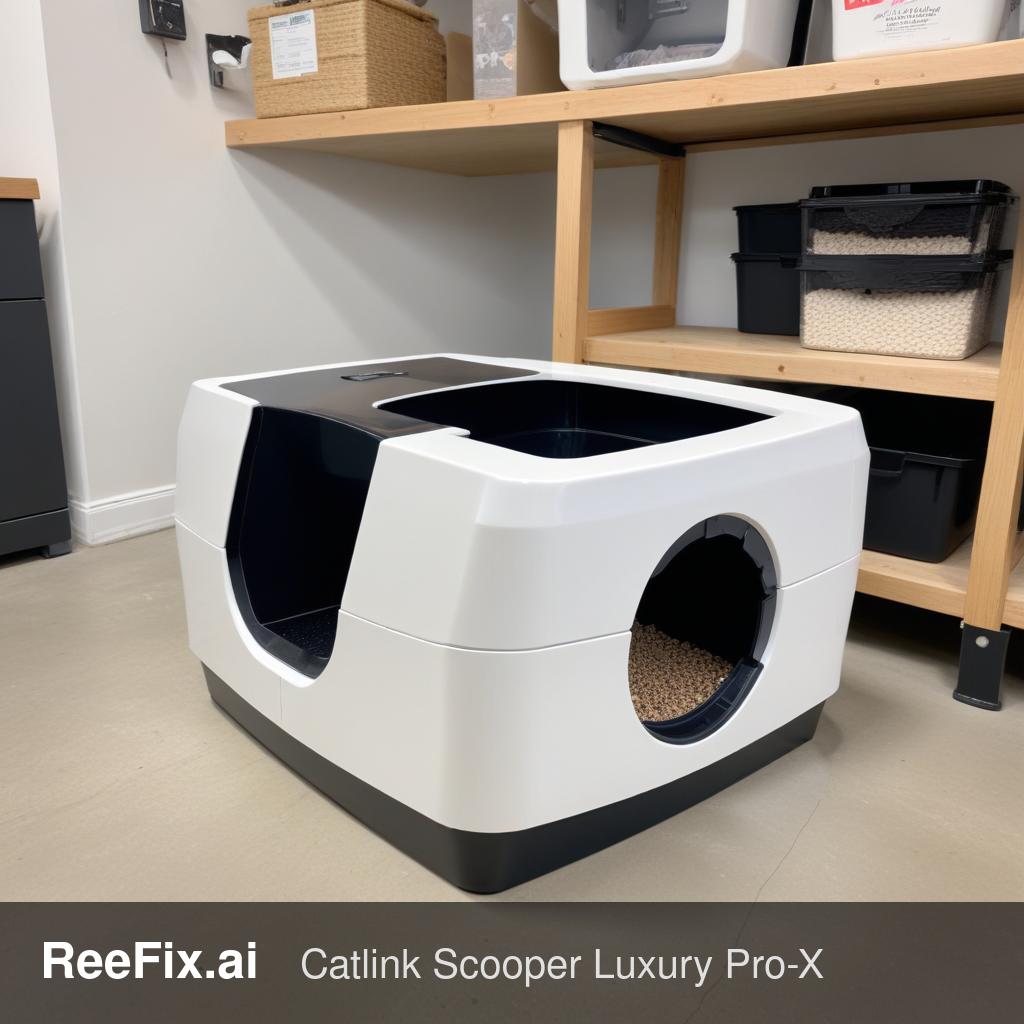
⚠️ SAFETY WARNING. This appliance is powered by low voltage (12V) via an external transformer connected to the 230V mains. Before any deep cleaning, maintenance, or disassembly, it is essential to unplug the power supply from the wall socket. When handling the drum and gears, pay utmost attention to the mechanical risk of finger crushing. If you do not feel confident performing these operations, it is recommended to rely on a qualified technician. ReeFix provides this diagnosis EXCLUSIVELY for educational and informational purposes.
REQUIRED TOOLS
For basic checks and potential DIY repairs, you might need:
- Isopropyl alcohol spray and a microfiber cloth: For cleaning optical sensors.
- Compressed air can: To remove litter dust and debris from gears.
- Silicone grease for plastic: For lubricating the drum's sliding guides.
- 12V 2A power supply (replacement, if necessary): To test power stability.
- Professional digital multimeter: Useful for verifying the power supply's voltage output.
- Screwdrivers (Phillips and flathead): For potential removal of protective casings.
PHASE 1: Quick Checks and Basic Solutions (High Probability - DIY)
This phase covers the most common and easy-to-solve causes, with a high probability of success without having to disassemble the litter box.
1. False detection by safety sensors and board lock (45% probability)
- Problem: The infrared sensors of the photoelectric barrier (located near the opening of the collection drawer) detect a non-existent obstacle, blocking the drum's rotation for safety. Often the logic board enters an error loop.
- Check and Solution:
- Hard Reset: Unplug the power supply from the wall socket and wait at least 5 full minutes. This allows the motherboard capacitors to discharge and reset the temporary lock state.
- Optical Cleaning: Use isopropyl alcohol spray and a microfiber cloth to thoroughly clean the infrared sensor lenses. Remove all traces of litter dust.
- Collection Bag Check: Ensure that the waste bag in the drawer is perfectly taut and that the edges do not protrude upwards, obstructing the optical sensors' path.
2. Misalignment or miscalibration of gravity sensors (30% probability)
- Problem: The weight sensors located under the base feet detect an anomalous variation, interpreting it as the presence of the cat inside the drum, stopping the cycle.
- Check and Solution:
- Support Surface: The Catlink Luxury Pro-X must rest on a perfectly rigid, flat, and stable floor. Absolutely avoid carpets, hygienic mats under the feet, or unstable surfaces. Ensure the casing does not touch surrounding walls or furniture.
- Manual Calibration Procedure: Unplug the appliance for 1 minute and reconnect it. Immediately place an object of known weight (1.5 kg) inside the empty drum. Press and hold the "Mode" button on the litter box until you hear an audible signal (beep) confirming the weight sensor has been recalibrated.
PHASE 2: Advanced Checks (Medium-Low Probability - Advanced DIY / Technician)
If the checks in Phase 1 did not resolve the blockage, the problem could be mechanical or related to internal components.
1. Excessive mechanical friction or motor overcurrent (15% probability)
- Problem: The accumulation of litter dust and debris between the drum's rack and the motor's gear increases friction. The board detects an electrical absorption peak (overcurrent) and blocks the motor to prevent it from burning out.
- Check and Solution:
- Deep Cleaning: Disconnect the power. Remove the dome (drum) and thoroughly clean the sliding guides on the base and the external rack of the drum using compressed air.
- Lubrication: Apply a light, even layer of silicone grease for plastic on the guides and gears to reduce mechanical friction.
2. Fault in the positioning system (Hall Sensors or Magnets) (7% probability)
- Problem: The litter box cannot determine the correct drum position due to misaligned or dirty limit magnets, or a defect in the Hall effect sensor.
- Check:
- Magnet Inspection: Disconnect the power and verify that the small magnets located on the back of the drum are clean and firmly in place. If you are familiar with electronics, you can use a professional digital multimeter to test the continuity of the sensor wirings on the motherboard.
3. Unstable electrical power supply (3% probability)
- Problem: The external 12V power supply does not provide stable current under load, causing micro-interruptions or voltage drops that lock the logic board during rotation.
- Check:
- If you notice obvious voltage drops or if the multimeter detects values below stable 12V during motor operation, replace the component with a compatible 12V 2A power supply.
FINAL VERIFICATION AND OPERATIONAL DECISION
After completing the checks, reconnect the litter box and perform an empty test cycle.
- Resolution with Phase 1 (75% of cases): If cleaning the optical sensors, repositioning the bag, or calibrating the weight resolves the problem, the litter box is ready for use. Monitor its behavior during the first few cycles.
- Resolution with Phase 2 (25% of cases): If the blockage persists, it may be necessary to replace worn components by purchasing specific replacement sensors or the gear motor.
- Repair Cost Analysis: Replacing sensors or the motor by a professional has an estimated cost between €40 and €100 for parts, plus approximately €50-€80 for labor (total €90-€180). Considering that a new Catlink Luxury Pro-X has a commercial value between €400 and €600, repair is highly convenient and recommended compared to purchasing a new device.
Why is my Catlink Luxury Pro-X stuck?
Common causes include false sensor detection, motor issues from litter dust, or power supply instability. Start with basic checks before deeper diagnosis.
How do I diagnose a stuck automatic litter box?
Begin by checking safety sensors for obstructions, verifying power supply voltage, and inspecting gears for debris. Listen for unusual motor sounds.
When should I call a technician for a stuck Catlink Luxury Pro-X?
If basic cleaning and power checks don't resolve the issue, or if you're uncomfortable with disassembly, it's best to consult a qualified technician.
This diagnostic report is generated using an artificial intelligence system (RAG) based on the aggregation of online data. The moderation by Luca Chia (Electronic Expert) validates its logical coherence and technical plausibility regarding the described symptoms, confirming the correctness of the AI's diagnostic reasoning, without however constituting an absolute guarantee of resolution for individual cases.