
De'Longhi PAC AN120HPE E1 error: Diagnosis and Solutions
Generated by ReeFix AI · Sources: technical and specialist documentation (see Sources section)
Revision of 13/07/2026
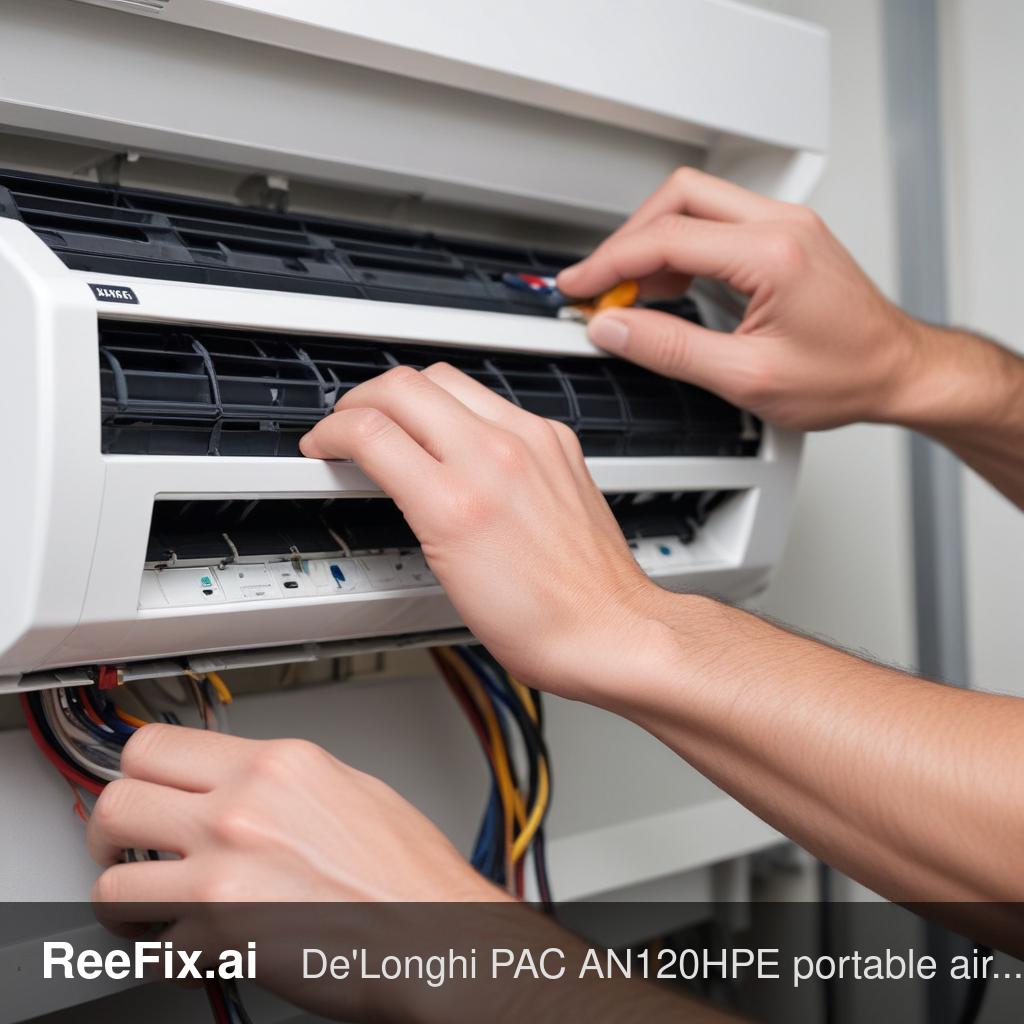
⚠️ SAFETY WARNING / ELECTRICAL HAZARD. This appliance operates at 230V mains voltage and contains compressor starting capacitors that can retain dangerous residual charges. Before any intervention, it is mandatory to physically unplug the appliance from the electrical outlet and wait for the capacitors to discharge. Opening the chassis exposes to severe electrical risk and it is strongly recommended to entrust it to a qualified technician. ReeFix provides this diagnosis EXCLUSIVELY for educational and informational purposes.
CAUSE A: Temperature Sensor (Ambient Probe) Fault or Overheating
Probability: High (55-65%). This is the most frequent cause and often solvable by replacing the probe or performing basic ventilation interventions. Key signals/indicators:
- E1 error displayed on the control panel (indicates an anomaly with the ambient probe).
- The unit does not cool at all, or the compressor starts for a few seconds and then locks up.
- The sensor detects out-of-range values (open or short circuit).
- Air filters visibly clogged or exhaust hose bent (causing abnormal overheating read by the probe as an error). Quick checks (DIY):
- Unplug the appliance from the electrical outlet.
- Clean the air filters: Remove the grilles, extract the filters, and wash them thoroughly, ensuring they are completely dry before reinserting them.
- Check the exhaust hose: Verify that the corrugated hot air exhaust duct is as straight as possible, unobstructed, free of kinks, and well connected to the window adapter. Ensure the external outlet is clear.
- Inspect the air intakes: Check that the rear and side intake grilles are not obstructed by furniture, curtains, or walls that are too close. Costs: Low. Filter maintenance and cleaning are free. If the ambient probe is open or short-circuited, purchasing a compatible replacement such as the temperature sensor for the De'Longhi PAC AN120HPE typically costs 15-40€. Expert insight: The E1 error specifically indicates a temperature probe anomaly. It often appears when the probe fails electrically, but it can also be triggered if it detects extreme thermal values due to internal overheating. A classic mistake is not leaving enough space (at least 30-50 cm) around the Pinguino to dissipate heat, or using non-original extensions for the exhaust hose.
CAUSE B: Main Control Board Issue
Probability: Medium (25-30%). Key signals/indicators:
- Persistent E1 error even after replacing or testing the temperature probe and verifying airflow.
- The compressor does not receive any start command from the electronic board.
- Potential other associated malfunctions (e.g., tangential fan not spinning, display flashing abnormally or not responding to commands).
- Presence of visible damage on the PCB (scorched components, broken traces, or swollen electrolytic capacitors) following technical inspection. Counter-examples: If the compressor attempts to start (emitting the classic surge) or the fans operate regularly for several minutes before locking up, it is unlikely that the main board is the primary cause of the fault. Costs: Medium-high. Purchasing a replacement main control board for the De'Longhi PAC AN120HPE can cost between 80 and 180€, plus specialized labor. On machines with many years of wear, this repair might be uneconomical. Safety notes: Accessing the electronic compartment requires removing the casing. It is imperative to operate with the plug disconnected, paying attention to the sharp edges of the internal metal sheets and charged capacitors. Technician output: Verify the visual integrity of the PCB, measure the output voltages from the transformer/switching power supply, and test the continuity of the relays that control the compressor. The use of a digital multimeter is essential to check if the probe reading circuit on the board is interrupted.
CAUSE C: Electrical or Mechanical Compressor Failure
Probability: Low (10-15%). This is the most serious and expensive anomaly. Key signals/indicators:
- The compressor does not start, remains silent, or emits a loud dull hum (failed start attempt) before the thermal protector (klixon) intervenes.
- The unit ventilates but does not dehumidify or cool in any way.
- The E1 error or general lockout occurs as a consequence of abnormal current draw or a failed refrigeration cycle (although E1 is primarily related to the probe, extreme overheating of a locked compressor can disrupt thermal readings). Counter-examples: If the compressor starts regularly but the air delivered is not cold, the problem is almost certainly related to a micro-leak of refrigerant gas in the sealed circuit, not a mechanical failure of the compressor itself. Costs: Very high. The eventual purchase and replacement of the compressor for the De'Longhi PAC AN120HPE requires the intervention of a licensed refrigeration technician (F-Gas) for refrigerant recovery, welding of the new component, nitrogen pressurization, vacuum, and recharging. The total cost (300-500€ for the part + specialized labor) almost always makes this operation uneconomical, making scrapping and purchasing a new Pinguino preferable. Mini-glossary: Refrigerant: the special gas (e.g., R410A, typical for this model) sealed within the refrigeration circuit which, by changing state, allows heat to be removed from the ambient air. Expert insight: Compressor failures in portable air conditioners are often caused by prolonged use with completely clogged filters or kinked exhaust hoses, conditions that prevent heat dissipation and make the motor operate at critical temperatures and pressures.
WHICH IS YOURS?
If, after thoroughly cleaning the filters and verifying that the exhaust hose is free and well extended (Cause A), the E1 error persists, it is necessary to contact a technician to check or replace the ambient probe. The cost of a potential temperature sensor is low, but its diagnosis requires disassembling the plastics and using a multimeter. If the technician confirms an electronic board problem (Cause B), carefully evaluate the repair quote by comparing it with the machine's residual value. If the final diagnosis points to an irreversible compressor failure (Cause C), the costs of restoring the refrigeration circuit make replacing the entire air conditioner by far the most logical and convenient choice.
Why does my De'Longhi PAC AN120HPE show E1 error?
The E1 error on De'Longhi PAC AN120HPE often indicates an ambient temperature sensor fault or overheating due to clogged filters/blocked exhaust.
What does E1 error mean on a portable AC unit?
E1 typically signals an issue with the ambient temperature sensor or a condition causing the unit to overheat, like restricted airflow.
When should I call a technician for an AC E1 error?
After checking filters and exhaust, if the E1 error persists, a qualified technician is recommended for sensor diagnosis or internal repairs due to electrical risks.
A useful technical tip from the community suggests that cleaning filters is often an effective solution for common issues, potentially avoiding higher repair costs.
This diagnostic report is generated using an artificial intelligence system (RAG) based on the aggregation of online data. The moderation by Luca Chia (Electronic Expert) validates its logical coherence and technical plausibility regarding the described symptoms, confirming the correctness of the AI's diagnostic reasoning, without however constituting an absolute guarantee of resolution for individual cases.