
Diagnosis Guide for Rowenta RO8371EA Vacuum Cleaner Suction Loss
Generated by ReeFix AI · Sources: technical and specialist documentation (see Sources section)
Revision of 13/06/2026
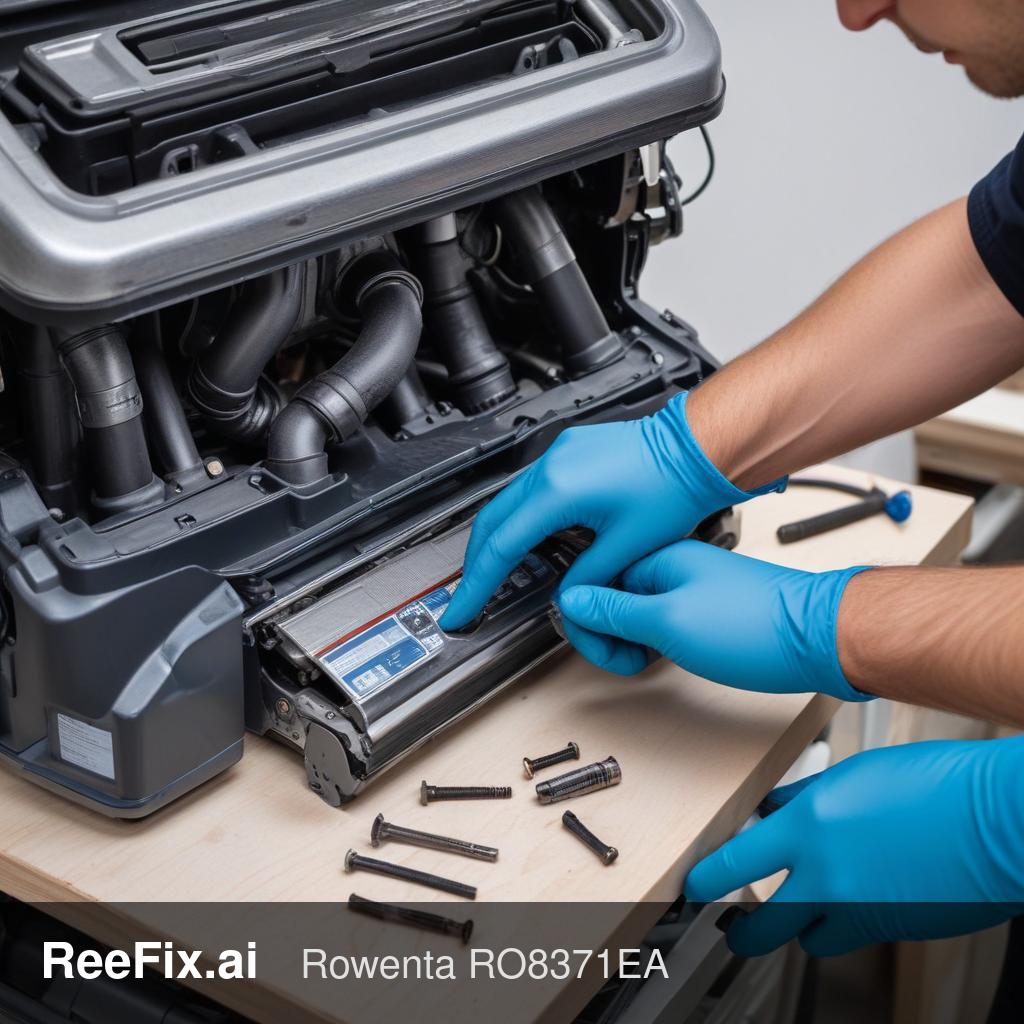
SAFETY WARNING. This appliance operates at mains voltage (230V). It is mandatory to always unplug the device from the electrical outlet before any inspection, disassembly, or deep cleaning. If physical intervention on the motor body proves complex, it is recommended to rely on a qualified technician for your safety. ReeFix provides this diagnosis EXCLUSIVELY for educational and informational purposes.
IF the vacuum cleaner loses suction (without immediate shutdown)
Quick checks (for the user):
- Empty the dust container: Ensure the bin is completely empty and that the internal multi-cyclonic block is not obstructed by trapped dust clumps.
- Check and clean/replace filters:
- Remove and thoroughly clean the pre-motor foam filter. Being washable, it is crucial to let it air dry completely (at least 24-48h) before reinserting it, to avoid drawing moisture into the motor.
- Inspect the Rowenta RO8371EA HEPA Filter located post-motor. If the paper pleats are gray, saturated with fine dust, or damaged, cleaning is not enough: it must be replaced.
- Inspect the air path: Check the nozzle, brush, metal telescopic tube, and the Rowenta RO8371EA Vacuum Cleaner Hose flexible hose to rule out obvious blockages (hair clumps, coins, debris stuck in bends).
Probability:
- Clogged or saturated filters: 60-75%
- Physical blockage in the cyclonic container or tubes: 20-30%
Costs:
- Low (Zero cost), if thorough cleaning and unblocking are sufficient.
- Medium-low (15-30€) for purchasing a new filter kit.
Key signs: The motor runs regularly, but the suction power at the brush is weak. Often, a high-pitched whistle or a dull noise is heard: this is air struggling to pass or the mechanical bypass valve opening to compensate for the abnormal vacuum.
Typical user error: Many underestimate the importance of maintaining the pre-motor foam filter. In cyclonic systems, if this filter becomes saturated (especially in the presence of pet hair or fine dust like plaster/flour), the airflow drops drastically, causing a constant loss of suction.
IF the vacuum cleaner loses suction, the motor overheats and shuts down by itself
Key signs/indicators: The motor emits a much duller and more strained noise than usual, the plastic casing becomes very hot to the touch, it might emit a strong smell of overheating (or burnt plastic), and the vacuum cleaner suddenly shuts down during use. This is not a random electrical fault, but the intervention of the safety thermostat (klixon) cutting off power to prevent motor meltdown.
Probability:
- Severe and persistent blockage in the air path (flexible hose or internal ducts obstructed): 50-65%. The motor runs idle without the necessary airflow for its own cooling.
- Filters completely cemented with dust and never replaced: 25-35%.
- Wear or failure of the Rowenta RO8371EA Vacuum Cleaner Motor (e.g., worn carbon brushes, damaged armature): 5-10%. Less likely as a primary cause, but often the final consequence of months of use with clogged filters.
Counter-examples: If the vacuum cleaner shuts down but is not hot, or if it doesn't turn on at all from the first attempt, the problem is not thermal but electrical (e.g., faulty power switch, power cord broken in the cord winder, or damaged plug).
Costs:
- Medium-high (40-80€) for replacing the complete flexible hose or for a technician's intervention to disassemble and unblock internal ducts.
- High (80-150€+) for replacing the motor block and associated labor.
Output for technician: The canister device exhibits severe suction loss, abnormal casing overheating, and automatic shutdown due to thermal protection intervention. I suspect a critical obstruction in the air path or a collapse of the filtration system preventing rotor cooling. The technician will need to verify the integrity of the air path, the condition of the cyclonic compartment's sealing gaskets, and, if the problem persists with filters removed, test the motor's electrical absorption to rule out an incipient short circuit in the windings.
THEN:
- If the quick checks solve the problem: Great, you've restored the appliance yourself. Remember to wash the sponge and tap the HEPA filter regularly.
- If the quick checks DO NOT solve AND the problem persists with overheating and shutdown: There is a deep obstruction inaccessible from the outside or the motor is compromised.
- Contact a technician: If the appliance is in good general condition, it's worth asking for a quote for an internal overhaul.
- Replace the device: If the vacuum cleaner has many years of service and the quote for motor replacement exceeds 100-120€, the repair cost might not be economically advantageous compared to purchasing a new model.
CONCLUSION
In a multi-cyclonic vacuum cleaner like the Rowenta RO8371EA, suction loss is almost always a fluid dynamics problem related to saturated filters or obstructed tubes. If thorough cleaning and filter replacement do not restore power, and the motor overheats to the point of shutting down due to thermal protection, it means the blockage is deep or the motor itself has suffered damage from strain. In these cases, if DIY is not enough, the intervention of a specialized technician is required.
This diagnostic report is generated using an artificial intelligence system (RAG) based on the aggregation of online data. The moderation by Luca Chia (Electronic Expert) validates its logical coherence and technical plausibility regarding the described symptoms, confirming the correctness of the AI's diagnostic reasoning, without however constituting an absolute guarantee of resolution for individual cases.