
Lavazza Jolie Plus Coffee Machine Not Heating: Diagnosis Guide
Validated by Luca Chia, Certified Electronic Technician
Revision of 15/06/2026
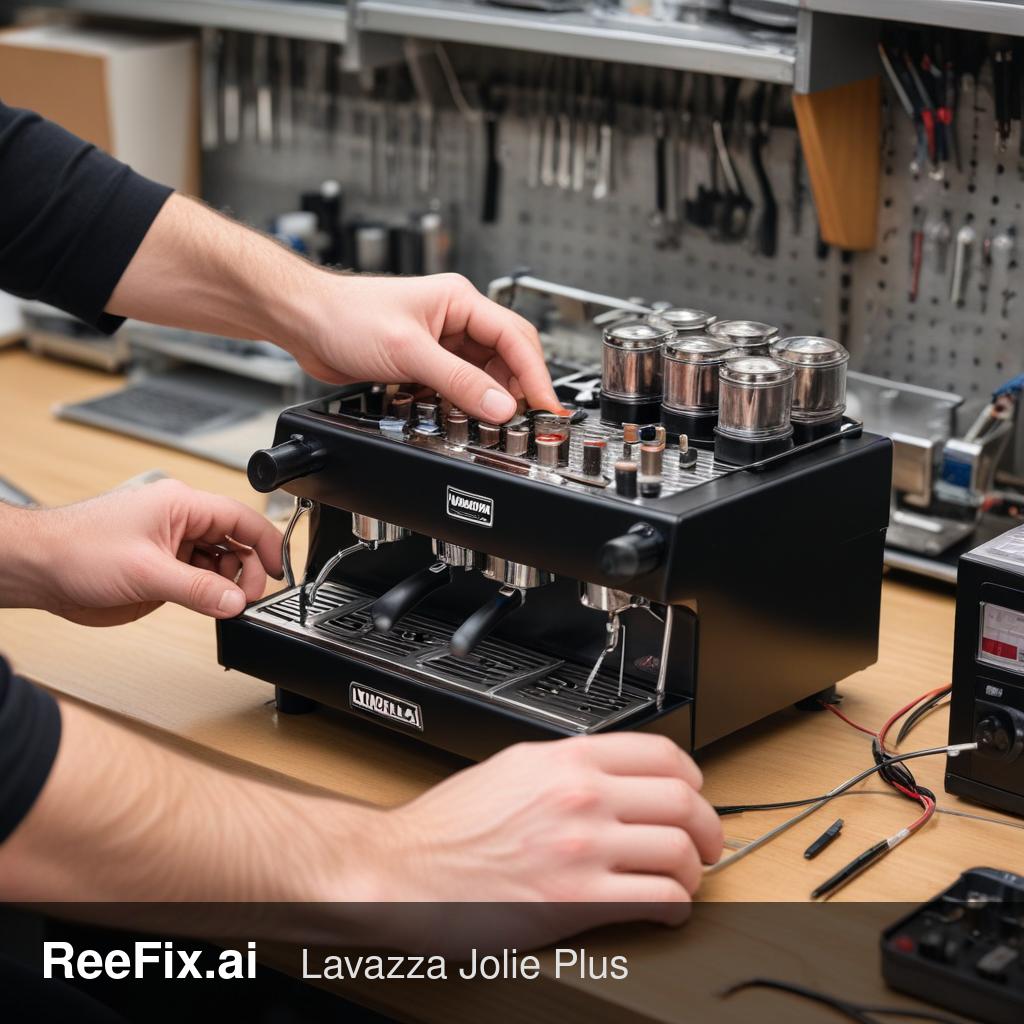
WARNING: This appliance is connected to the 230V electrical grid and handles water. It is mandatory to always unplug it from the socket and empty the water tank before any disassembly to avoid the risk of electric shock. If the physical intervention is complex, it is recommended to rely on a qualified technician for your safety. ReeFix provides this diagnosis EXCLUSIVELY for educational and informational purposes.
CHECK 1: Thermal Fuse and Thermoblock Heater
Probability: High (60-75% for faulty fuse/heater). This is the most common fault when the machine does not heat. The thermal fuse is a single-use safety device: if the thermoblock overheats, it breaks to prevent fires. The heater is the integrated element that physically produces heat. Key signs: The dispensing buttons continue to flash indefinitely without ever becoming steady (the machine does not reach "ready" temperature), or they flash rapidly indicating a system anomaly. In some cases, the pump starts but dispenses cold water. Tools needed: Multimeter (continuity and resistance function), Torx/security screwdrivers.
Quick checks:
- Unplug the machine from the power outlet and remove the water tank.
- Remove the outer casing to access the thermoblock (the metal block located inside, connected to the Teflon tubes).
- Locate the thermal fuses (usually small cylindrical components wrapped in silicone insulating sleeves, fixed in contact with the thermoblock or wired in series).
- With the multimeter, test the continuity of the thermal fuses. If there is no continuity (the multimeter indicates "OL" or an infinite value), the fuse has blown.
- Without disconnecting the heater from the thermoblock, measure its electrical resistance across its main terminals. The typical value for a coffee machine heater of this wattage is between 40 and 60 Ohms. If the multimeter indicates "OL" (open circuit), the internal resistance of the thermoblock is burned out.
Estimated cost (parts): Thermal fuse: €5-15. Complete Lavazza Jolie Plus thermoblock (includes heater): €30-60. Often happens when... The thermal fuse blows. However, it is almost never the primary cause of the problem, but a consequence of excessive overheating, often due to an inaccurate NTC sensor (see Check 2) or severe limescale buildup. Replacing only the fuse without investigating the root cause often leads to an immediate new failure.
CHECK 2: NTC Sensor (Thermistor)
Probability: Medium (20-30%). The NTC sensor constantly monitors the thermoblock temperature and communicates with the motherboard. If it provides incorrect readings, the control board will not activate heating or will put the machine into a preventive block. Key signs: The machine goes into a block (rapid LED flashing) immediately after switching on, without even attempting to heat the block. Tools needed: Multimeter (resistance function).
Quick checks:
- Unplug the machine from the power outlet.
- Locate the NTC sensor, usually a small component screwed or clipped directly onto the metal body of the thermoblock, with two thin wires going to the board.
- Disconnect the NTC sensor connector from the board and measure its resistance at room temperature (approx. 20-25°C). Typical values for these machines are often in the order of tens of kOhms (e.g., 10kOhm, 50kOhm or 100 kOhm at 25°C, depending on the revision).
- A value clearly out of scale (e.g., 0 Ohms, indicating a short, or "OL", indicating an open circuit) confirms that the sensor is faulty.
Estimated cost (part): Lavazza Jolie Plus NTC sensor: €15-30. Typical user error: Not considering that the sensor might only be "out of calibration" and not completely interrupted. A sensor that reads slightly offset values tricks the machine's logic, causing it to block or blow the thermal fuses.
CHECK 3: Wiring, Connections, and Motherboard
Probability: Low (10-15%). Loose cables, oxidized fastons, or a burned relay on the motherboard can prevent proper current flow to the thermoblock. Key signs: The machine is completely dead, or the defect is intermittent and only occurs sometimes.
Quick checks:
- Unplug the machine from the power outlet.
- With the machine open, visually inspect all cables and connectors (fastons) that connect the control board to the thermoblock.
- Look for signs of burns, melted plastic on connectors, or oxidation (green/white film) due to internal micro-water leaks.
- Visually inspect the motherboard for blackened components or swollen capacitors.
Estimated cost: €0 (if it's a matter of tightening a loose faston) or €40-70 (if a new motherboard is needed). Edge case: Water pump vibrations, over time, can loosen less secure connectors.
CONCLUSION
To decide quickly:
- If CHECK 1 (Thermal Fuse or Thermoblock Heater) indicates a fault:
- Repair it yourself (Low-medium cost, medium difficulty): If you are skilled with a multimeter and disassembly, you can replace the fuse (€5-15) or the complete thermoblock (€30-60). Remember to also check the NTC sensor if the fuse was blown.
- Replace the device (Recommended choice if not repairing DIY): Consulting a technician to replace a thermoblock on this model involves labor and spare parts costs (€80-€150) that exceed or equal the value of a new Lavazza Jolie Plus (€80-€120). Professional intervention is uneconomical.
- If CHECK 2 (NTC Sensor) indicates a fault:
- Repair it yourself (Low cost, medium difficulty): Replacing the NTC sensor (€15-30) is an economical and definitive intervention, highly recommended if you have a minimum of manual skill.
- Consult a technician (Medium cost): The replacement of only the sensor by a professional could cost between €50 and €80. Evaluate based on the age and general condition of the machine.
- If CHECK 3 (Wiring and Connections) reveals problems:
- Repair it yourself (Almost no cost, low difficulty): Often it is enough to tighten a faston with pliers or clean an oxidized contact. This is the simplest and cheapest attempt to make with the machine open.
Operational decision: The heating system fault on compact capsule machines requires careful economic evaluation. If the problem is a simple NTC sensor or wiring (Checks 2 and 3), DIY repair is very convenient. If the thermoblock is burned out (Check 1), proceed only if you are able to do the work yourself; otherwise, buying a new machine is the most financially logical choice.
Why is my Lavazza Jolie Plus coffee machine not heating up?
Common causes include a faulty thermal fuse or thermoblock heater. Buttons flashing indefinitely or rapidly, or cold water dispensing, are key signs.
How can I diagnose a coffee machine that isn't heating?
Check for flashing lights or cold water. A multimeter can test the thermal fuse and thermoblock for continuity/resistance.
When should I call a technician for a coffee machine not heating?
If electrical work or disassembly is complex, or initial checks fail, a qualified technician is recommended for safety and accurate diagnosis.
This diagnostic report is generated using an artificial intelligence system (RAG) based on the aggregation of online data. The moderation by Luca Chia (Electronic Expert) validates its logical coherence and technical plausibility regarding the described symptoms, confirming the correctness of the AI's diagnostic reasoning, without however constituting an absolute guarantee of resolution for individual cases.