
Miele W1 WCR870WPS Washing Machine F138 Error Diagnosis
Generated by ReeFix AI · Sources: technical and specialist documentation (see Sources section)
Revision of 14/06/2026
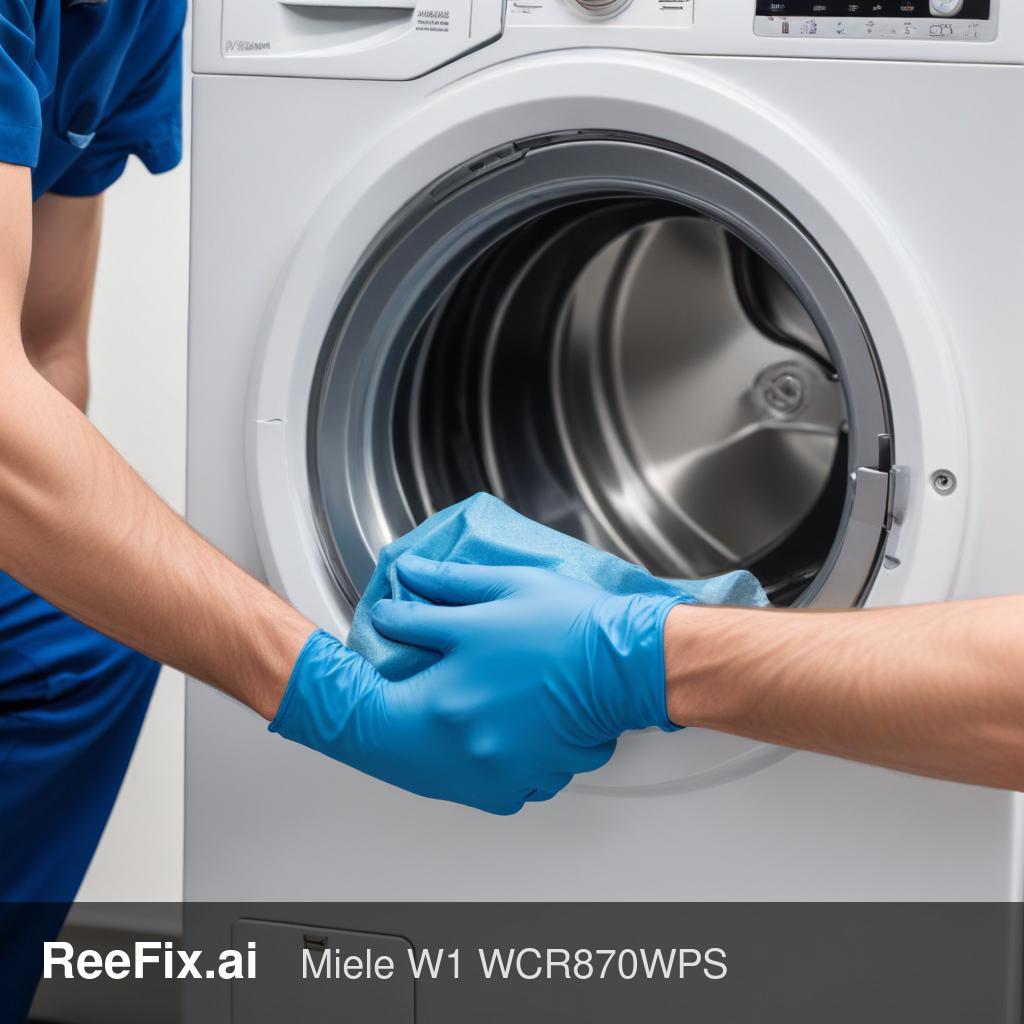
WARNING: ELECTRICAL AND MECHANICAL RISK. Before any intervention, disconnect the washing machine from the power outlet or deactivate the main circuit breaker. Accessing internal components for bearing replacement requires complete disassembly of the machine, exposing sharp metal sheets and requiring the handling of very heavy concrete counterweights. It is strongly recommended to rely on a qualified technician. ReeFix provides this diagnosis EXCLUSIVELY for educational and informational purposes.
CAUSE A: Severely Worn Drum Bearings
Probability: 70-85%
The F138 error on a Miele W1 WCR870WPS indicates the activation of the anti-flood system (Waterproof system), meaning the float has detected water at the bottom of the washing machine. If this error appears together with a loud grinding or "roaring" noise during the spin cycle, the culprit is the failure of the drum bearings and its seal. The connection is mechanical: excessive drum play wears out the seal, water leaks through, washing away the grease and corroding the bearings (generating the deafening noise), and then drains to the bottom of the machine, triggering the F138 error.
Key signs/indicators:
- Metallic, rubbing, or "roaring" noise that worsens with increasing spin speed.
- The drum has excessive play if you try to move it manually up and down or back and forth relative to the tub.
- The F138 error appears concurrently with the noise, and water is noticeable in the bottom tray.
Quick checks (for a technician):
- Disconnect the machine: Ensure the washing machine is unplugged from the power.
- Check for water leak: Slightly tilt the machine backward (with a cloth ready) to check if water comes out from the bottom, confirming the leak.
- Drum rotation test: Open the door and try to spin the drum by hand: if you feel resistance, rubbing noises, or significant play, the bearings are compromised.
- Vertical movement test: Push the drum upwards and then release it: if it "drops" with a thud or has a non-fluid movement, it's another sign.
Costs and Technical Specifications: The replacement kit typically costs between 50-120 euros. Attention: many Miele W1 series models feature a heat-sealed polycarbonate tub. If your sub-model has an openable tub (or if the technician performs a custom cutting and heat-sealing intervention), individual spare parts can be used. Otherwise, the entire tub assembly will need to be replaced. Labor costs are very high (200-400 euros) given the complexity of the intervention.
Output for technician: "Bearing noise and F138 (water leak in the base). Inspect bearings, drum seal, and check if the tub is heat-sealed or openable."
CAUSE B: Deteriorated Drum Seal (Oil Seal)
Probability: High (as a triggering cause for Cause A and F138 error)
The drum seal (or oil seal) is the main barrier preventing water from escaping the tub. It is the direct cause of the water leak that triggers the F138 error at the bottom of the machine, and it is the root of the bearing damage. If this seal hardens, cracks, or deforms, water infiltration compromises the bearings in a short time. This often happens when the machine is several years old, has been used with overly aggressive detergents, or constantly overloaded.
Key signs/indicators:
- Similar to those of worn bearings (noise, play).
- Traces of rust, limescale, or dark streaks on the back of the tub or under the machine, an unequivocal sign of the leak.
- The F138 error manifests by safely locking the machine.
Counter-examples: If the machine goes into F138 error but the drum spins perfectly silently and smoothly, the water leak comes from another part (e.g., hoses, detergent drawer, drain pump) and the bearings are intact.
Costs: The seal is always replaced along with the bearings. The cost is included in the bearing kit.
Typical user error: Ignoring the first light noises during the spin cycle, thinking they are "normal" signs of aging. This leads to the complete failure of the oil seal and subsequent internal flooding (F138).
CAUSE C: Damaged Drum Spider (Spider Arm)
Probability: Medium (20-30%, often a consequence of Causes A/B)
The drum spider is the three-armed metal support that connects the inner drum to the shaft and bearings. If the bearings fail and the drum starts to oscillate abnormally, the stresses on the spider increase drastically. Moisture and detergent residues that bypass the broken oil seal can also cause galvanic corrosion, weakening the aluminum structure. A broken spider causes extreme drum instability, destroying the tub and leading to the massive water leak that triggers the F138.
Key signs/indicators:
- In addition to bearing noise, you might hear a "clunk" or an abnormal, dull knocking sound, especially when the drum changes direction.
- The drum appears visibly misaligned, "sagging" to one side, or rubbing against the door seal.
- Extreme vibrations that cause the entire washing machine to move during the spin cycle.
Mini-glossary:
- Spider (or spider arm): Star-shaped metal component fixed to the back of the stainless steel drum, connecting it to the motor shaft.
Necessary tools (for technician):
- Washing machine bearing puller
- Set of Torx wrenches and sockets for tub and counterweight disassembly
- Drum spider (spider arm)
Costs: The spider is an expensive spare part (100-250 euros or more for Miele) and its replacement requires the same complete disassembly as the bearings. If the spider is also damaged, or if the tub is heat-sealed and irremediably damaged by rubbing, the repair almost certainly becomes uneconomical.
WHICH IS YOURS?
Considering the F138 error (water leak) and the specific noise during the spin cycle, the most probable diagnosis is a failure of the drum bearings (CAUSE A), triggered by a faulty seal allowing water to escape (CAUSE B). A damaged spider (CAUSE C) is a secondary possibility, often a consequence of prolonged wear, which further exacerbates the problem.
Operational decision: If the manual drum test reveals evident play or noise and the machine signals F138, contact a qualified technician. The repair is complex, requires total disassembly, is expensive in labor, and often uneconomical (especially if the model has a heat-sealed tub). If the technician confirms damaged bearings and/or spider requiring replacement of the entire tub assembly, seriously consider replacing the entire washing machine instead of repairing it, especially if the appliance is more than 7-8 years old.
This diagnostic report is generated using an artificial intelligence system (RAG) based on the aggregation of online data. The moderation by Luca Chia (Electronic Expert) validates its logical coherence and technical plausibility regarding the described symptoms, confirming the correctness of the AI's diagnostic reasoning, without however constituting an absolute guarantee of resolution for individual cases.