
Olympus OM-5 Water Ingress: Diagnosis and Solutions
Generated by ReeFix AI · Sources: technical and specialist documentation (see Sources section)
Revision of 22/06/2026
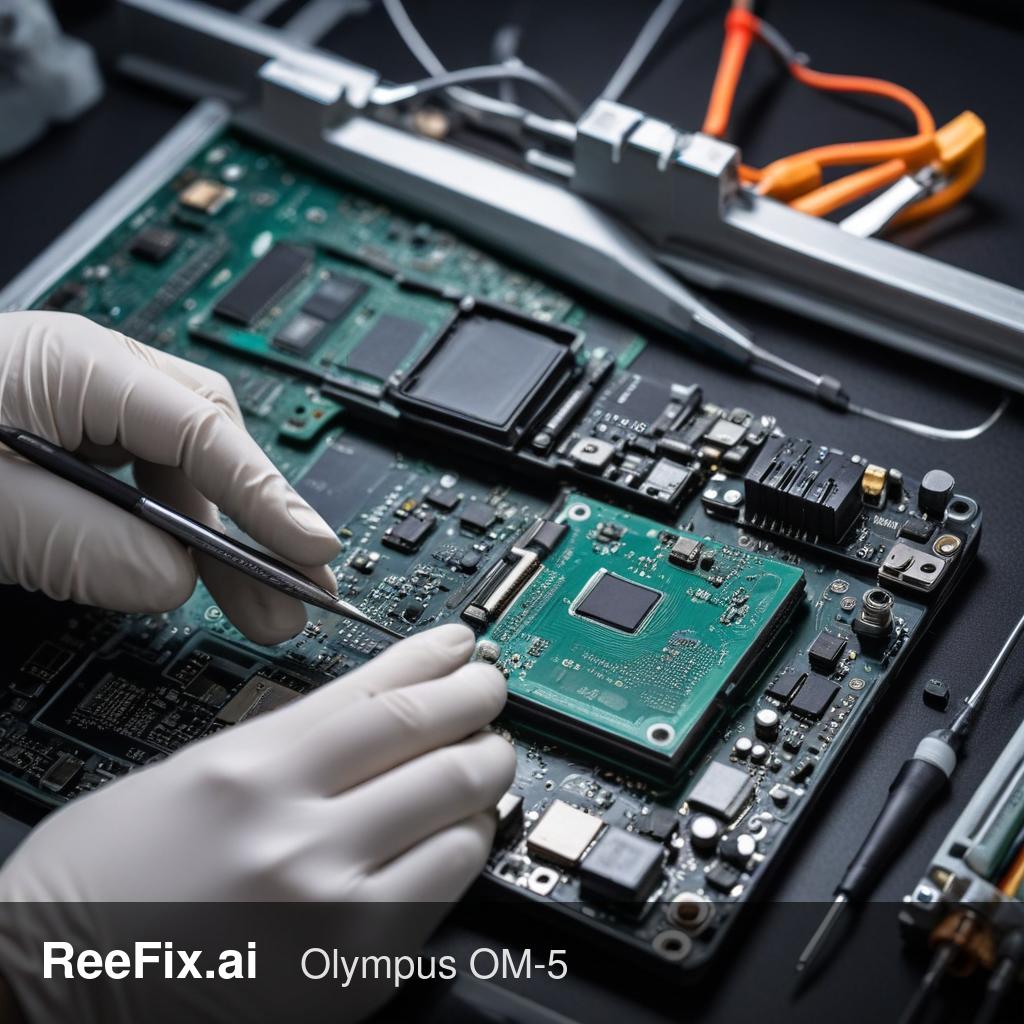
⚠️ SAFETY WARNING / FIRE HAZARD. This device contains lithium batteries. Improper puncturing or bending during disassembly can cause explosions or flames. The intervention requires precision and the assistance of a specialized technician is recommended. ReeFix provides this diagnosis EXCLUSIVELY for educational and informational purposes.
TECHNICAL ANALYSIS
Water ingress in the Olympus OM-5, despite its IP53 certification, indicates exceeding protection limits or a failure of the seals. Water inside an electronic device is a critical threat and acts quickly.
Main causes and probability of damage:
- Corrosion of the motherboard and critical circuits (electrolysis): High (45-55%)
- Why: Water, especially if not distilled (rainwater, salt water, lake water), contains minerals that make it an electrical conductor. The presence of residual voltage (even when the camera is off, due to the buffer battery) triggers electrolysis, which corrodes copper traces and component pins (e.g., TruePic IX image processor) within hours, creating permanent short circuits.
- Key signs: The camera does not turn on at all, turns on for an instant and then off, random errors or non-specific system messages appear, burning smell.
- Common mistake: The rice myth is harmful. Rice absorbs moisture too slowly and releases dust/starch that mixes with water, creating a conductive and corrosive paste that worsens the damage. It is a false remedy.
- Damage to the IBIS unit (5-axis image stabilization): Medium (25-35%)
- Why: The IBIS system is a high-precision mechanism with electromagnetic coils and micro-bearings. Humidity can oxidize the coils or seize the bearings.
- Key signs: Abnormal noises on startup or during use, sensor lock, consistently blurry images even with fast shutter speeds, specific stabilization-related errors.
- Ingress from the lens mount and damage to sensor/shutter: Medium (15-20%)
- Why: If non-weather-sealed lenses or lenses with faulty seals are used, or if mounting is imprecise, water can directly seep onto the electrical contacts of the mount, reaching the sensor chamber.
- Key signs: Water droplets or oxidation on the gold contacts of the mount or inside the sensor chamber, spots or halos on the sensor or low-pass filter, shutter jammed or not firing correctly.
- Damage to sealing gaskets and internal condensation: Low (5-10%)
- Why: Wear or a defect in the seals (doors, dials) is the initial cause of ingress. Subsequent temperature fluctuations can cause trapped water to condense on internal optical surfaces (EVF, sensor), promoting mold growth.
- Key signs: Persistent internal humidity, halos or fogging in the electronic viewfinder or on the display, mold growth on internal lenses or the sensor.
SECONDARY FACTORS
Quick checks (non-invasive for the user):
- Immediately remove the battery: This is the first and most important action to stop electrolysis. Do not turn the camera back on.
- Visually inspect: Check battery/SD card doors, lens mount, buttons, and dials for obvious traces of water, residues, or oxidation.
- Surface drying: Gently blot the exterior with an absorbent cloth. Do not use direct heat sources (hair dryer).
Tools needed (for a technician):
- JIS precision screwdriver kit
- 99.9% Isopropyl alcohol
- ultrasonic cleaner for electronic boards
- Silica gel packets for drying
- specific replacement seals
Output for technician (synthetic handoff): "Liquid ingress (specify type: fresh/salt/chlorinated). Camera immediately turned off. Request microscopic inspection of Main PCB, Live MOS sensor FPC connectors, and IBIS module for corrosion/deposits. Perform ultrasonic cleaning with isopropyl alcohol if necessary. Do not power on before visual verification. Check door and mount seals."
WHAT TO DO
Do not attempt DIY repair. The risk of irreversible damage (electrolysis, IBIS) is very high, and the necessary tools and skills are professional.
Since the most probable and serious damages in case of water ingress concern the motherboard (45-55%) and the IBIS stabilization system (25-35%), the timeliness of the intervention is fundamental to determine whether the camera is repairable or if it is better to replace it.
- If you decide to attempt repair (recommended for cameras with high residual or sentimental value):
- Immediately contact a specialized technician. Time is crucial to prevent irreversible circuit corrosion. A professional will disassemble the camera, perform a chemical wash, and decontaminate the components. Repair costs for water ingress can be high, starting from approximately 200-300 euros, but are justified if they save a camera body worth over 1000 euros.
- If the damage is extensive or repair is uneconomical:
- Consider replacing the device. If electrolysis has already destroyed the motherboard traces or if the IBIS module is completely oxidized, the cost of spare parts and labor will exceed the residual value of the camera. In this case, purchasing a new Olympus OM-5 or an equivalent model is the most sensible choice.
Why is my Olympus OM-5 not turning on after water exposure?
Water ingress likely caused motherboard corrosion and short circuits due to electrolysis, even with residual voltage. This often results in the camera failing to power on or displaying immediate error
What are the immediate signs of water damage in a camera?
Look for the camera not turning on, random errors, a burning smell, or intermittent power. These indicate critical internal damage, often from corrosion.
Is the rice trick effective for water-damaged electronics?
No, the rice trick is harmful. It's too slow and can introduce dust/starch, creating a corrosive paste that worsens internal damage. Professional diagnosis is essential.
This diagnostic report is generated using an artificial intelligence system (RAG) based on the aggregation of online data. The moderation by Luca Chia (Electronic Expert) validates its logical coherence and technical plausibility regarding the described symptoms, confirming the correctness of the AI's diagnostic reasoning, without however constituting an absolute guarantee of resolution for individual cases.