
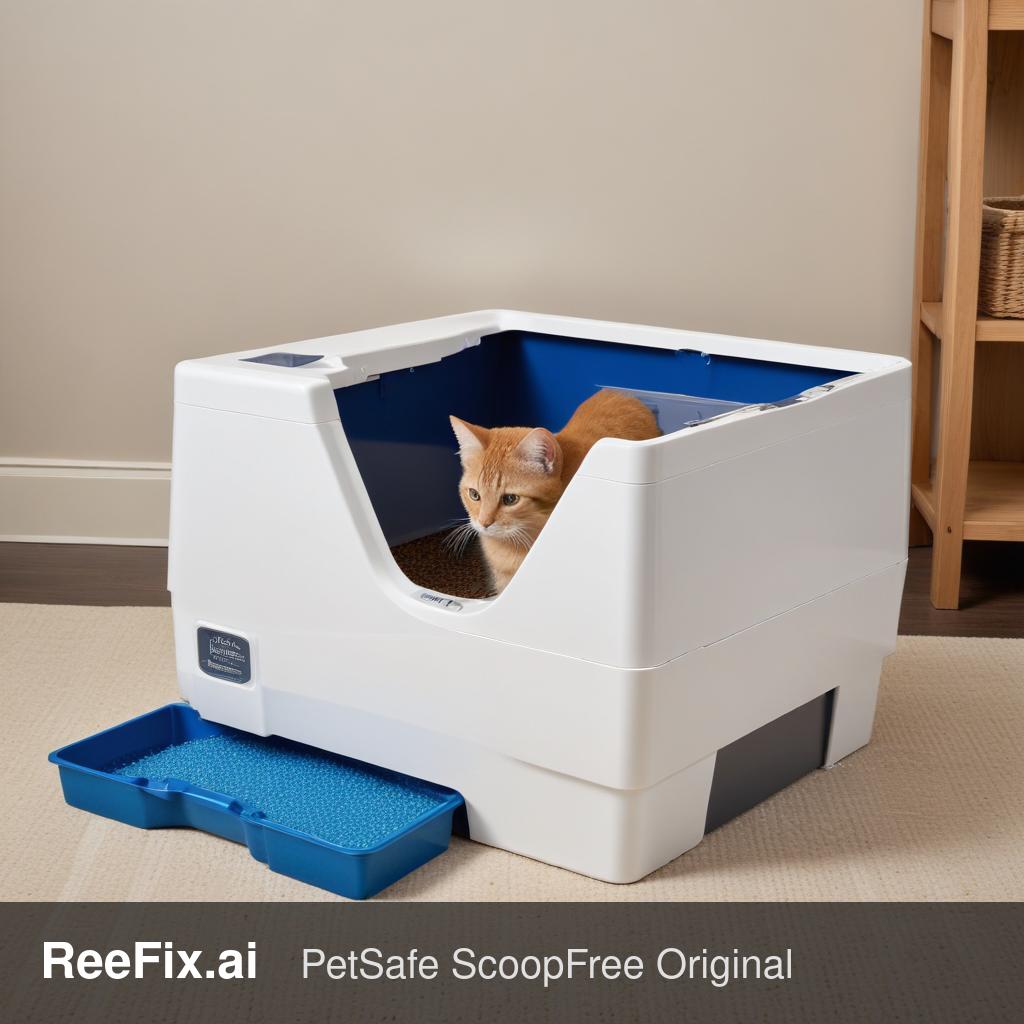
PetSafe ScoopFree Original: Rake Stuck and Diagnosis
Generated by ReeFix AI · Sources: technical and specialist documentation (see Sources section)
Revision of 26/06/2026
⚠️ SAFETY WARNING. This appliance is powered by an external low-voltage power supply (18V DC), but connected to the 230V mains. It is imperative to unplug the power supply from the wall socket before any cleaning or disassembly to avoid short circuits or damage to the electronic board. Pay attention to moving mechanical parts (the rake) to prevent finger crushing hazards. If physical intervention proves complex, it is recommended to rely on a qualified technician. ReeFix provides this diagnosis EXCLUSIVELY for educational and informational purposes.
OBSERVED SYMPTOMS
- The rake is completely stuck and immobile.
- The motor does not start, produces no noise, or emits an almost imperceptible hum followed by inactivity.
- The cleaning cycle does not start, even after attempting a reset or reconnecting power.
WHAT TO EXCLUDE
- Total power failure: If the device emits a minimal hum or the LEDs briefly light up, the power supply is not completely dead.
- Complex software issues: Most blockages in these systems are mechanical or electrical in nature, not requiring firmware intervention.
- Lack of litter: The device does not detect the presence or absence of litter; the lack of crystals does not mechanically block the rake or prevent the cycle from starting.
ROOT CAUSE
The rake blockage in the PetSafe ScoopFree Original almost always results from a conflict between a physical obstruction and the electronic protection system. The diagnosis aims to quickly isolate the primary cause.
- Mechanical Obstruction or Excessive Friction (Probability: 60-75%)
- Explanation: The most frequent cause. Accumulations of litter crystals, hair, or dirt in the side rails or under the rake carriage create such high friction that the motor cannot move. The logic board detects excessive current draw and cuts power to prevent damage to the motor or gears (overcurrent protection).
- Key Signals: The rake is difficult to move manually when the device is off. The motor makes no noise or produces a brief "click" followed by silence.
- Quick Checks: 1. Unplug the device. 2. Completely remove the litter and waste tray. 3. Thoroughly clean the side rails and the underside of the rake. Look for jammed foreign objects. 4. Try to move the rake manually: it should slide effortlessly.
- Costs: Low (DIY cleaning).
- Prevention Tip: Regular cleaning of the rails and rake, especially under the carriage, is essential. This problem often happens when non-specific litter is used or maintenance is neglected.
- Defective or Dirty Limit Switches (Microswitches) (Probability: 15-20%)
- Explanation: Microswitches indicate the exact position of the rake to the control board. If one of these sensors is blocked (open or closed) by dirt, oxidation, or an internal fault, the board receives an inconsistent signal and, for safety, inhibits motor startup. The humid and vapor-rich environment can oxidize the contacts.
- Key Signals: The motor does not start, but the device appears powered. Sometimes a faint "click" is heard but no movement.
- Quick Checks: 1. Unplug the device. 2. Locate the microswitches (usually at the ends of the rake's path). 3. Check for obstructions or bent levers. 4. Use an electrical contact cleaner to clean the contacts and manually actuate the lever several times.
- Costs: Low (cleaning) to Medium (microswitch replacement, approximately €5-15 per component, requires soldering).
- Defective External Power Supply (Probability: 5-10%)
- Explanation: The power supply may deliver the nominal voltage at no load, but fail to provide the peak current required for motor startup. This causes a "voltage sag" that leads to continuous control logic resets or failure to start.
- Key Signals: No signs of life or the device turns on for an instant and then turns off. LEDs might flash abnormally.
- Quick Checks: 1. With a digital multimeter, measure the output voltage of the power supply. If it is correct at no load, it does not rule out a problem under load. 2. If available, test the device with a compatible, working PetSafe ScoopFree power supply.
- Costs: Medium-Low (power supply replacement, approximately €15-30).
- Damaged Gearbox or DC Motor (Probability: 5-10%)
- Explanation: Stripped plastic gears in the gearbox or a replacement PetSafe ScoopFree DC motor with broken windings or worn brushes. This is often a consequence of repeated mechanical blockages. Even if the motor receives voltage, it cannot turn, activating the protection.
- Key Signals: A slight constant hum from the motor but no rake movement, or the rake moves in jerks with abnormal noises.
- Costs: High (motor/gearbox replacement, approximately €30-60 for the spare part, plus labor). Repair is often uneconomical compared to the value of a new device.
- Urine Corrosion or Logic Board Damage (Probability: Low, but Serious)
- Explanation: Feline urine, rich in salts and acids, can infiltrate and damage wiring, connectors, or the main electronic board, causing short circuits or interruptions. This is structural damage and often irreversible for the user.
- Key Signals: Urine odor or visible signs of corrosion/oxidation on internal circuit boards.
- Costs: Very high (logic board replacement, often not available as a spare part or too expensive).
Output for technician: "The PetSafe ScoopFree Original device exhibits total rake blockage with no motor startup. Severe mechanical obstruction, microswitch anomaly (dirty/faulty), or switching power supply failure under load is suspected. Verify: 1) Free mechanical movement of the rake post-cleaning. 2) Continuity and status of microswitches. 3) Power supply voltage stability under inductive load. 4) Integrity of gearbox assembly and DC motor."
CONCLUSION AND OPERATIONAL DECISION
Based on the probability of the analyzed causes, here's how to proceed to solve the problem:
- First intervention (Most probable cause - 60-75%): Perform a deep cleaning of the side rails and the rake. Remove all litter residue or dirt. If the rake moves freely again, you have solved it at no cost.
- Second intervention (Medium cause - 15-20%): If the blockage persists, check the limit microswitches and clean them with an electrical contact cleaner.
- Third intervention (Medium-low cause - 5-10%): Test the external power supply with a multimeter or try a compatible one. If defective, replacement costs approximately €15-30 and is very simple.
- Serious cases (Rare/complex cause - <10%): If the problem lies in the motor, gearbox, or logic board (perhaps corroded by urine), repair requires advanced technical skills and expensive spare parts. In this scenario, complete device replacement is often the most cost-effective choice.
Why is my PetSafe ScoopFree Original rake stuck and not moving?
The rake blockage in the PetSafe ScoopFree Original is almost always due to mechanical obstruction or motor failure, not software issues or lack of litter.
How do I diagnose a stuck rake on an automatic litter box?
Check for a complete lack of movement, no motor noise, or a faint hum followed by inactivity. Exclude total power failure if LEDs briefly light up.
When should I call a technician for a stuck litter box rake?
If physical intervention seems complex or you suspect an internal electrical or mechanical fault beyond simple clearing, it's best to consult a qualified technician.
This diagnostic report is generated using an artificial intelligence system (RAG) based on the aggregation of online data. The moderation by Luca Chia (Electronic Expert) validates its logical coherence and technical plausibility regarding the described symptoms, confirming the correctness of the AI's diagnostic reasoning, without however constituting an absolute guarantee of resolution for individual cases.