
Smeg ST4523IN Dishwasher Door Spring Broken: Repair Guide
Generated by ReeFix AI · Sources: technical and specialist documentation (see Sources section)
Revision of 16/06/2026
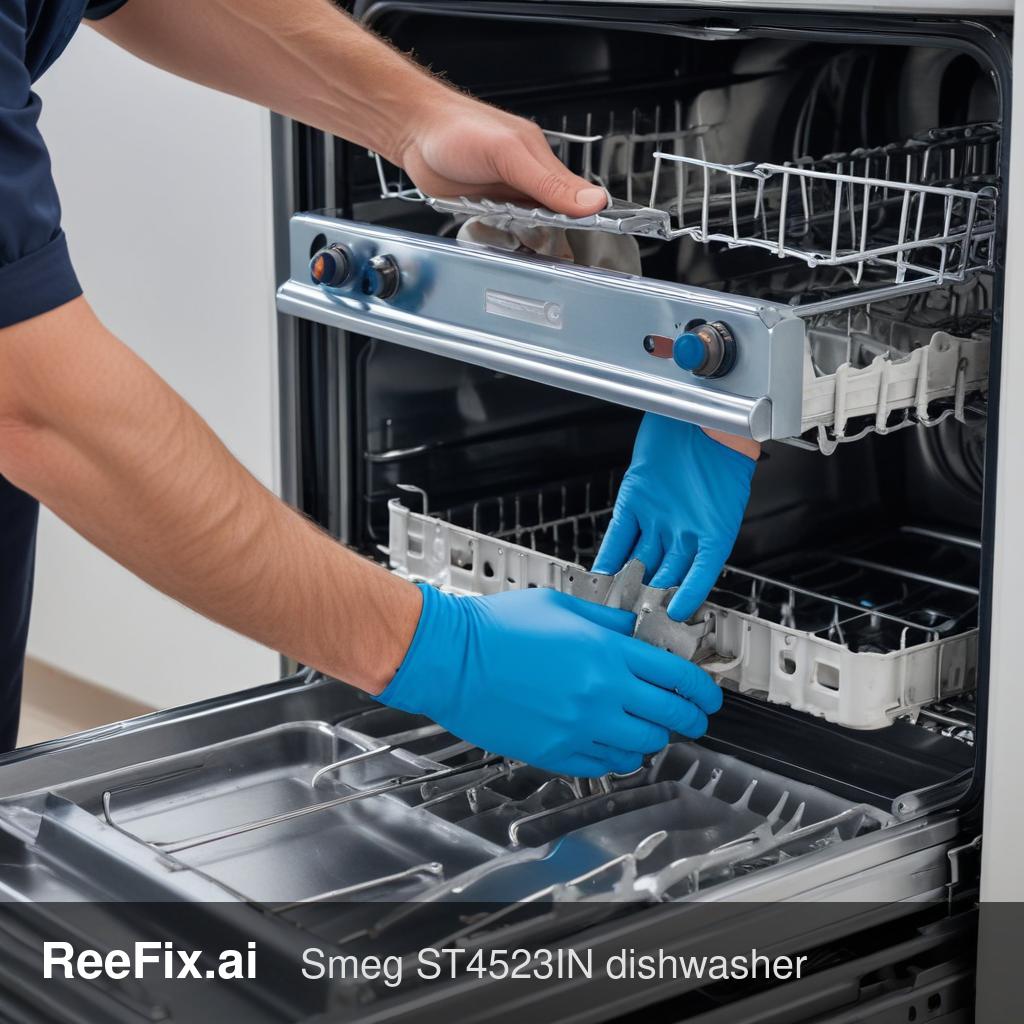
⚠️ SAFETY WARNING / ELECTRICAL AND MECHANICAL RISK. This appliance operates at 230V. Before any intervention, it is mandatory to unplug it or deactivate the main circuit breaker. Furthermore, the door balancing system is subject to strong mechanical tension: accidental release or breakage of the springs during handling can cause serious hand injuries (snap effect) or sudden door collapse. ReeFix provides this diagnosis EXCLUSIVELY for educational and informational purposes.
TECHNICAL ANALYSIS
The problem of the Smeg ST4523IN dishwasher door not staying open and closing by itself (or falling heavily downwards) is a symptom almost always related to the balancing system. This mechanism, fundamental for safety and ease of use, is composed of tension springs, return cables, and pulleys located on the sides of the appliance.
- Main cause (probability 70-85%): Breakage or weakening of the door balancing spring. The springs are subjected to continuous cycles of tension and compression. Over time, this mechanical stress, aggravated by environmental factors such as humidity and temperature fluctuations, leads to material fatigue and, finally, to breakage or significant loosening. A damaged spring can no longer counterbalance the weight of the door.
- Why it happens: Mechanical wear is the most common cause. Every time the door opens and closes, the spring works. After thousands of cycles, the metal gives way.
- Replacement cost (spring): Approximately 15-35€ for a replacement spring compatible with Smeg ST4523IN.
- Secondary cause (probability 10-20%): Breakage or misalignment of the hinge cable. The cable (or tensioner) connecting the spring to the door hinge can fray, break, or detach from its guide pulley. If the connection is interrupted, the spring's force is not transmitted to the door, generating the exact same symptom as a broken spring.
- Replacement cost (cable/belt): Approximately 10-25€ for a hinge cable or belt for this model.
- Less common cause (probability 5-10%): Worn/blocked pulley or damaged hinges. The return pulleys (often made of plastic material) can crack or seize, preventing the smooth sliding of the cable and causing its premature breakage. In rare cases, the metal hinges themselves may have bent due to excessive load (e.g., leaning on the open door), interfering with the balancing.
Key signs/indicators:
- The door falls heavily downwards or snaps shut as soon as it is released, without maintaining intermediate positions.
- Often the problem is asymmetrical: if the mechanism on only one side fails, the door might be slightly crooked or offer abnormal resistance.
Necessary tools (for experienced user or technician):
- A pair of sturdy pliers.
- Screwdriver set (including Torx, typical for European appliances).
Safety notes:
- Always disconnect the appliance from the electrical supply. Intact springs are under strong tension: handling them without due precautions or with inadequate tools can cause injuries.
SECONDARY FACTORS
Quick Diagnosis Checklist:
-
Does the door fall heavily? (Yes/No) -> Indicates broken spring/cable.
-
Is the door crooked? (Yes/No) -> Indicates an asymmetrical problem (only one side).
-
Is the appliance more than 5-7 years old? (Yes/No) -> Increases the likelihood of mechanical wear.
-
General wear and age: This problem occurs almost exclusively in dishwashers with several years of intensive use, typically over 5-7 years.
-
Risk of additional damage: Using the dishwasher with an unbalanced door abnormally stresses the remaining spring (accelerating its breakage) and can deform the hinges. Furthermore, a door that does not close in alignment risks wearing out the perimeter gasket, causing water leaks during washing.
-
Typical user error: Abrupt opening or closing of the door, or placing excessive weight on the open door (e.g., baskets full of dishes left resting for extended periods), enormously stresses the cables and springs.
Estimated repair costs:
- DIY repair (parts cost only): 15-40€ (for the spring or cable kit). As it is a built-in model, the intervention requires unscrewing the dishwasher from the cabinet, partially pulling it out, and removing the sheet metal side panels to access the mechanism.
- Repair with technician: 95-190€ (parts + labor). Labor includes extraction from the cabinet, diagnosis, replacement of the tensioners (it is always recommended to change them in pairs), and leveling the appliance.
WHAT TO DO
- Repair it yourself (if you have the skills and tools): It is almost certain that it is a broken spring or cable (cost 15-40€). The intervention requires disconnecting the appliance, pulling it out of the kitchen compartment, and disassembling the sides. It is an absolutely feasible operation for those with DIY experience, but requires caution for handling springs under tension. It is advisable to replace components on both sides to avoid a new failure soon.
- Contact a technician (if you lack experience or don't feel confident): The total cost (parts + labor) will be between 95€ and 190€. This is the mandatory choice if you are not familiar with extracting built-in appliances or if you fear mechanical injuries.
- Replace the appliance (if it is very old): If the dishwasher is more than 8-10 years old and has already shown other problems (e.g., with the drain pump or the control board), evaluate whether the cost of 150-190€ for a technician is justified. It might be time to invest in a new, more efficient appliance.
Operational decision: If the door falls or does not maintain its position, mechanical failure of springs or cables is confirmed. Evaluate your DIY skills for an economical repair (15-40€) or call a technician (95-190€); if the appliance is at the end of its useful life, consider replacement.
Why does my Smeg ST4523IN dishwasher door not stay open?
The door not staying open or falling is usually due to a broken or weakened balancing spring. Mechanical wear from thousands of cycles is the primary cause.
What causes a dishwasher door to fall heavily?
A heavy or collapsing dishwasher door almost always indicates a fault in the door balancing system, most commonly a broken or fatigued tension spring.
Is a broken dishwasher door spring expensive to fix?
The spring itself is generally inexpensive, but professional replacement is recommended due to high mechanical tension and potential injury risks.
This diagnostic report is generated using an artificial intelligence system (RAG) based on the aggregation of online data. The moderation by Luca Chia (Electronic Expert) validates its logical coherence and technical plausibility regarding the described symptoms, confirming the correctness of the AI's diagnostic reasoning, without however constituting an absolute guarantee of resolution for individual cases.