
Speed Queen TR5000WN: Motor Sensor Fault Diagnosis
Generated by ReeFix AI · Sources: technical and specialist documentation (see Sources section)
Revision of 20/06/2026
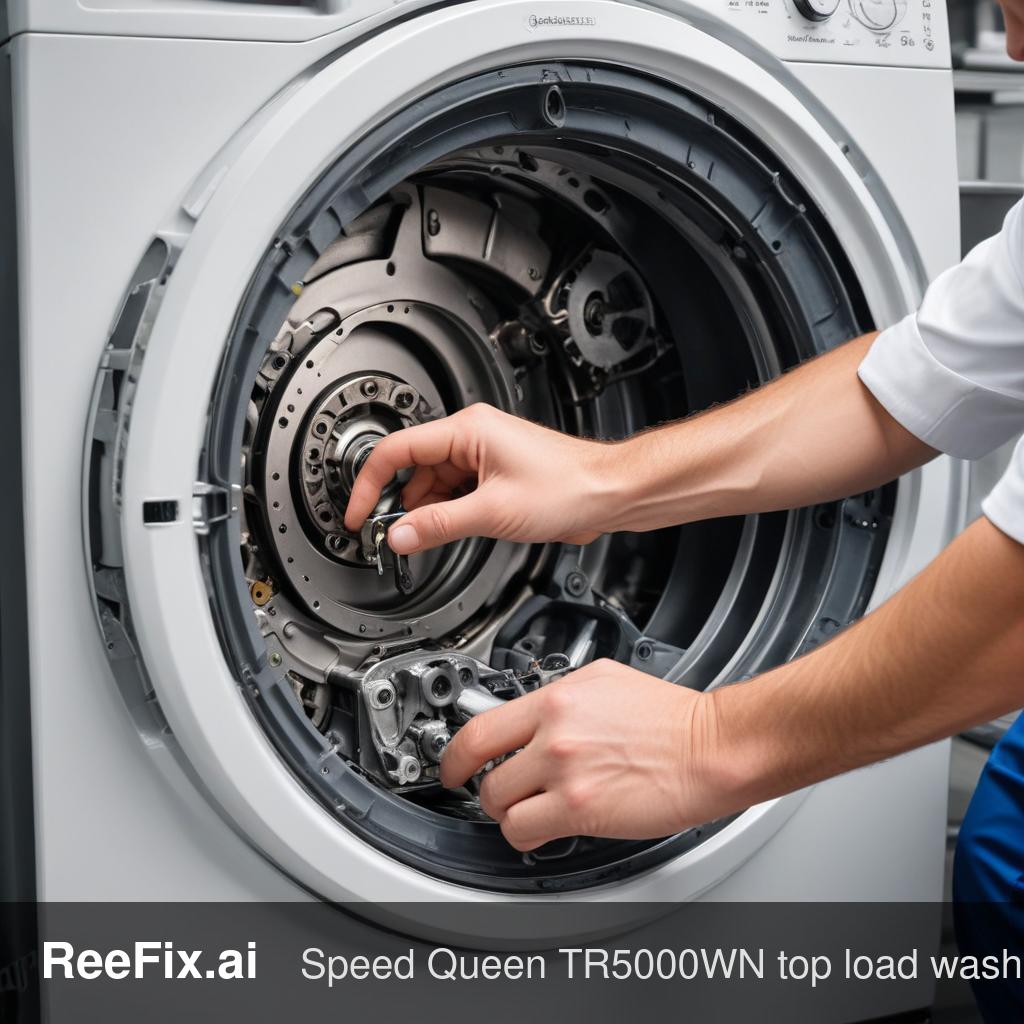
⚠️ SAFETY WARNING / ELECTRICAL AND MECHANICAL RISK. This appliance operates at mains voltage. Before any inspection, it is mandatory to unplug the appliance or deactivate the main circuit breaker. Physical intervention on internal components, particularly near the motor assembly and belts, carries serious risks of electric shock and mechanical injury. It is strongly recommended to entrust the diagnosis to a qualified technician. ReeFix provides this diagnosis EXCLUSIVELY for educational and informational purposes.
MAIN CAUSE
The motor sensor fault (indicated by a specific flashing sequence of status lights) on your Speed Queen TR5000WN washing machine indicates that the control board is not receiving correct signals from the position or speed sensor (often a Hall sensor). This blocks operation to prevent mechanical damage.
The most probable causes are:
- Defective motor sensor: High Probability (60-65%). This is the most common cause. The tachometer sensor, exposed to vibrations and humidity near the tub assembly, can deteriorate or fail.
- Key signs: The motor does not start rotating or hums without spinning, the spin cycle does not start, the washing machine stops prematurely with flashing lights.
- Why: The sensor no longer sends essential feedback to the board, which consequently cuts power to the motor for safety.
- Damaged wiring or connectors: Medium Probability (20-25%). The wires connecting the sensor to the control board (drive board) may be broken, loose, or corroded.
- Key signs: Intermittent fault, visible signs of oxidation or damage to connectors near the motor or board.
- Why: A physical break prevents the sensor signal from reaching the electronic board.
- Defective main or drive control board (PCB): Low Probability (10-15%). Less frequent, but the board might not process input signals correctly.
- Key signs: Sensor and wiring appear intact during multimeter tests, but the error persists. Sometimes accompanied by other malfunctions.
- Why: A burnt component on the board prevents the reading or interpretation of the signal from the sensor.
- Minor/mechanical causes: Very Low Probability (5%). Excessive overload or an item of clothing stuck between the drum and the outer steel tub can brake the motor, generating abnormal feedback that the system detects as a sensor error.
VERIFICATION
To identify the cause, a qualified technician would perform the following steps:
- Visual Inspection (with appliance unplugged from the mains):
- Check the speed sensor and its wiring, located near the motor stator or pulley assembly. Look for signs of physical damage, burns, corrosion on connectors, or frayed wires.
- Verify that there are no foreign objects stuck between the drum and the outer tub. A drum that turns with strong resistance by hand may indicate a mechanical blockage.
- Continuity and Resistance Test (with multimeter):
- After disconnecting the connectors, the technician measures the continuity of the wiring from the sensor to the board. A break indicates the need to replace the cables.
- Measure the resistance of the sensor itself, comparing the values with Speed Queen's technical specifications. Abnormal values or an open circuit confirm component failure.
- Tools: A digital multimeter is essential for these diagnostic tests.
- Power Supply Verification (technician only):
- A professional verifies that the control board provides the correct DC voltage to the sensor. In case of absent voltage, the problem lies with the board.
- Typical error: Attempting to test live components without the necessary expertise, with a very high risk of electric shock.
OPERATIONAL OUTCOME
Given the technical complexity and electrical risks, "DIY" intervention is strongly discouraged for most users.
Quick Decision in 60 seconds:
- Repair yourself (NOT RECOMMENDED):
- Only if you have advanced electromechanical experience and a multimeter. The cost of a motor sensor for Speed Queen TR5000WN generally ranges between 30€ and 80€, while a motor wiring harness for Speed Queen TR5000WN has a similar price. Access difficulty is high, requiring removal of the front panel or access from the bottom.
- Often happens when: the user attempts repair without unplugging the appliance or without discharging the inverter board capacitors, risking serious injury.
- Contact a technician (RECOMMENDED CHOICE):
- This is the safest and most definitive solution. A technician will accurately diagnose whether the fault lies in the sensor, wiring, or board.
- Estimated costs: * Spare parts (sensor/wiring): 30€ - 80€. * Control board: 150€ - 300€ (if it were necessary to replace the main control board for Speed Queen TR5000WN, the cost is higher). * Labor: 80€ - 150€.
- Estimated total: 110€ - 230€ for sensor/wiring; 230€ - 450€ for the control board.
- Output for technician: "Speed Queen TR5000WN washing machine, rotation blockage with flashing lights (motor sensor error). Diagnosis priority: Hall sensor resistance test, wiring continuity to the drive board, verification of voltages output from the board."
- Replace the device (IF NECESSARY):
- Consider replacement if: * The estimated repair cost exceeds 450€ - 500€ (approximately 40-50% of the value of a new Speed Queen) and the machine has more than 10-15 years of intensive wear. * However, given the brand's high build quality, repair is almost always the most economically sensible choice.
Conclusion: The highest probability is a fault with the speed sensor or its wiring. Considering the high value of a Speed Queen washing machine, repair by a specialized technician is the most logical and cost-effective choice in the vast majority of cases.
Why does my Speed Queen TR5000WN have a motor sensor fault?
Likely a defective motor sensor (60-65% probability) or damaged wiring, preventing the control board from receiving motor speed signals.
What are the common signs of a washing machine motor sensor fault?
Motor hums but doesn't spin, spin cycle fails, or the machine stops prematurely with error lights. The control board isn't getting motor feedback.
Can I diagnose a washing machine motor sensor fault myself?
Due to high electrical and mechanical risks, professional diagnosis is strongly recommended. ReeFix provides info for educational purposes only.
This diagnostic report is generated using an artificial intelligence system (RAG) based on the aggregation of online data. The moderation by Luca Chia (Electronic Expert) validates its logical coherence and technical plausibility regarding the described symptoms, confirming the correctness of the AI's diagnostic reasoning, without however constituting an absolute guarantee of resolution for individual cases.