
Technics SL-1200 Turntable Speed Fluctuation Diagnosis Guide
Generated by ReeFix AI · Sources: technical and specialist documentation (see Sources section)
Revision of 05/05/2026
⚠️ WARNING SERIOUS RISK. This appliance operates with potentially dangerous components (high voltage, high temperatures, or gases). Improvised repairs on critical devices can be fatal or prohibited by law. Physical intervention requires qualified specialized technicians to issue compliant safety certificates. ReeFix provides this diagnosis EXCLUSIVELY for educational and informational purposes.
INITIAL REAL CASE
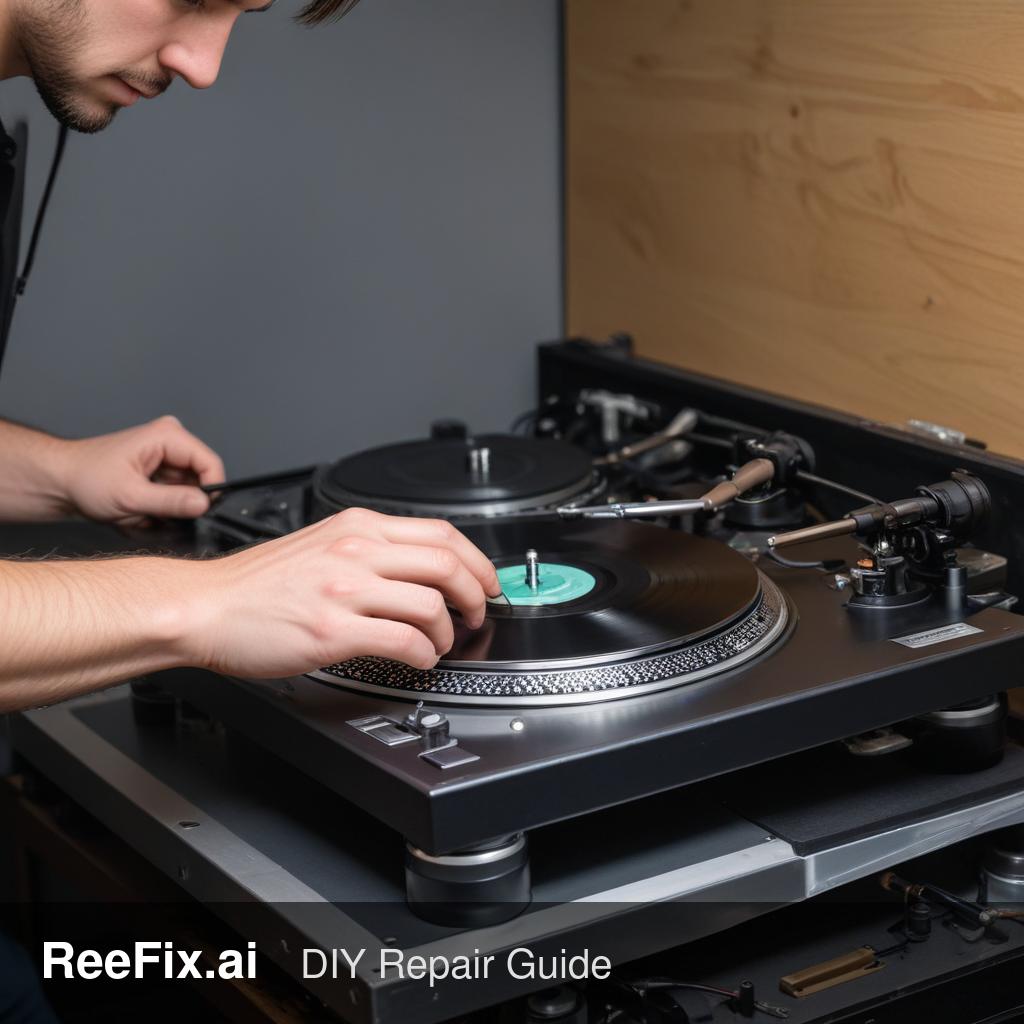
Your Technics SL-1200 shows speed fluctuations. The record slows down and speeds up slightly during playback, making listening unpleasant. Sometimes, by barely moving the pitch control lever, the speed seems to stabilize momentarily, only to become unstable again. The problem occurs at both 33 and 45 RPM, and it is not related to a belt – the SL-1200 is direct-drive.
IMMEDIATE DIAGNOSIS
Here are the most probable causes for speed fluctuations on your Technics SL-1200, ordered by probability:
- Dirty/Worn Pitch Control Fader (60%): The most common problem. Dirt and oxidation on the internal contacts create erratic resistances, altering the motor's speed reference.
- Electrolytic Capacitors on Motor Control Board (25%): With age, these capacitors lose efficiency (ESR increases, capacitance decreases), destabilizing the local power supply or the motor's timing circuits.
- Electrolytic Capacitors in Power Supply (10%): An unstable or "noisy" power supply does not provide the clean current needed by the control board, compromising speed stability.
- Quartz Lock Circuit Issues (4%): Less frequent, an unstable quartz oscillator or its associated components can generate an incorrect frequency reference.
- Motor or Encoder Issues (1%): Extremely rare on Technics direct-drive motors. Often accompanied by mechanical noises or abnormal resistance to rotation.
QUICK TEST
To isolate the most probable cause:
- Pitch Fader Test: Slowly move the Technics SL-1200 Pitch Control Fader through its entire range. If the speed fluctuates more noticeably, becomes erratic during movement, or at specific "dead spots," it's a strong indication. You can try spraying some DeoxIT D5 Contact Cleaner inside the fader (if accessible) and operating it repeatedly to attempt a superficial cleaning.
- Careful Listening: Start the turntable without a record. Listen for any unusual mechanical noises coming from the motor or platter. A well-functioning Technics SL-1200 motor is almost silent.
- Internal Inspection (for qualified technicians only): If you have internal access and are a qualified technician, inspect the motor control board and power supply. Look for signs of deterioration on the capacitors, such as bulging or leaks.
MOST PROBABLE DIAGNOSIS
In the majority of cases (approximately 60%), speed fluctuations are due to a dirty or worn Technics SL-1200 Pitch Control Fader. Its resistive contacts degrade with use and time, sending unstable reference signals to the speed control circuit. Even if it's not touched, internal oxidation can cause unpredictable and annoying resistance variations.
SOLUTION AND REAL COSTS
- Pitch Fader Cleaning:
- Parts cost: DeoxIT D5 Contact Cleaner (15-30€).
- Labor cost: 30-60€ (if the fader is easily accessible without complex disassembly).
- Pitch Fader Replacement:
- Parts cost: Technics SL-1200 Pitch Control Fader (40-100€, depending on the specific model and availability).
- Labor cost: 80-150€ (requires soldering and extensive disassembly of the unit).
- Capacitor Replacement (recap):
- Parts cost: Electrolytic Capacitor Kit for Audio Equipment (20-60€ for a complete kit for the main boards).
- Labor cost: 150-300€ (longer and more delicate intervention, especially if it involves multiple boards and requires significant disassembly).
COMMON ERRORS
- Looking for a drive belt: The Technics SL-1200 is a direct-drive turntable. It does not have belts. Any search or attempt to replace one is useless and misleading.
- Spraying cleaner indiscriminately: Using non-specific products or excessive amounts can damage electronic components or leave corrosive residues. Use only specific products for electronic contacts like DeoxIT D5 Contact Cleaner.
- Ignoring capacitors: Even if they show no obvious damage, electrolytic capacitors age and lose efficiency. This can cause intermittent problems that are difficult to isolate, making a "recap" a preventive or necessary solution.
REAL CASES
- Professional DJ (Fader Issue): A DJ who has used the SL-1200 for years in smoky environments noticed that the speed "jumped" especially when moving the pitch fader. The problem persisted even with the fader stationary, but less noticeably. A technician, after disassembling the fader, found high resistance and oxidation on the contacts. A thorough cleaning with DeoxIT D5 temporarily resolved it, but given the wear, replacement of the Technics SL-1200 Pitch Control Fader was recommended to ensure long-term stability.
- Hi-Fi Collector (Capacitor Issue): An SL-1200, left in an attic for 15 years, exhibited random speed fluctuations, unrelated to the pitch fader. A technician, measuring voltages with a Digital Multimeter, detected a "noisy" power supply and high ESR on several capacitors on the motor control board. A complete recap with an Electrolytic Capacitor Kit for Audio Equipment restored perfect stability.
- Used Purchase (Mixed Issue): A user bought a used SL-1200 with minor fluctuations. After cleaning the fader, the problem decreased but persisted. The technician then identified two deteriorated capacitors on the power supply board. Their replacement definitively resolved the fluctuations, demonstrating how sometimes multiple causes contribute to the problem.
WHEN IT'S NOT THIS
If, after ruling out the fader and capacitors, the instability persists, a more in-depth investigation is needed. It could be a problem with the quartz lock circuit (rare, but possible, requires an oscilloscope and frequency counter) or, in extremely exceptional cases, a problem with the motor itself (wear of bearings or the magnetic encoder). These are complex scenarios, requiring a technician with advanced instrumentation and access to the Technics SL-1200 Service Manual for accurate diagnosis.
This diagnostic report is generated using an artificial intelligence system (RAG) based on the aggregation of online data. The moderation by Luca Chia (Electronic Expert) validates its logical coherence and technical plausibility regarding the described symptoms, confirming the correctness of the AI's diagnostic reasoning, without however constituting an absolute guarantee of resolution for individual cases.