
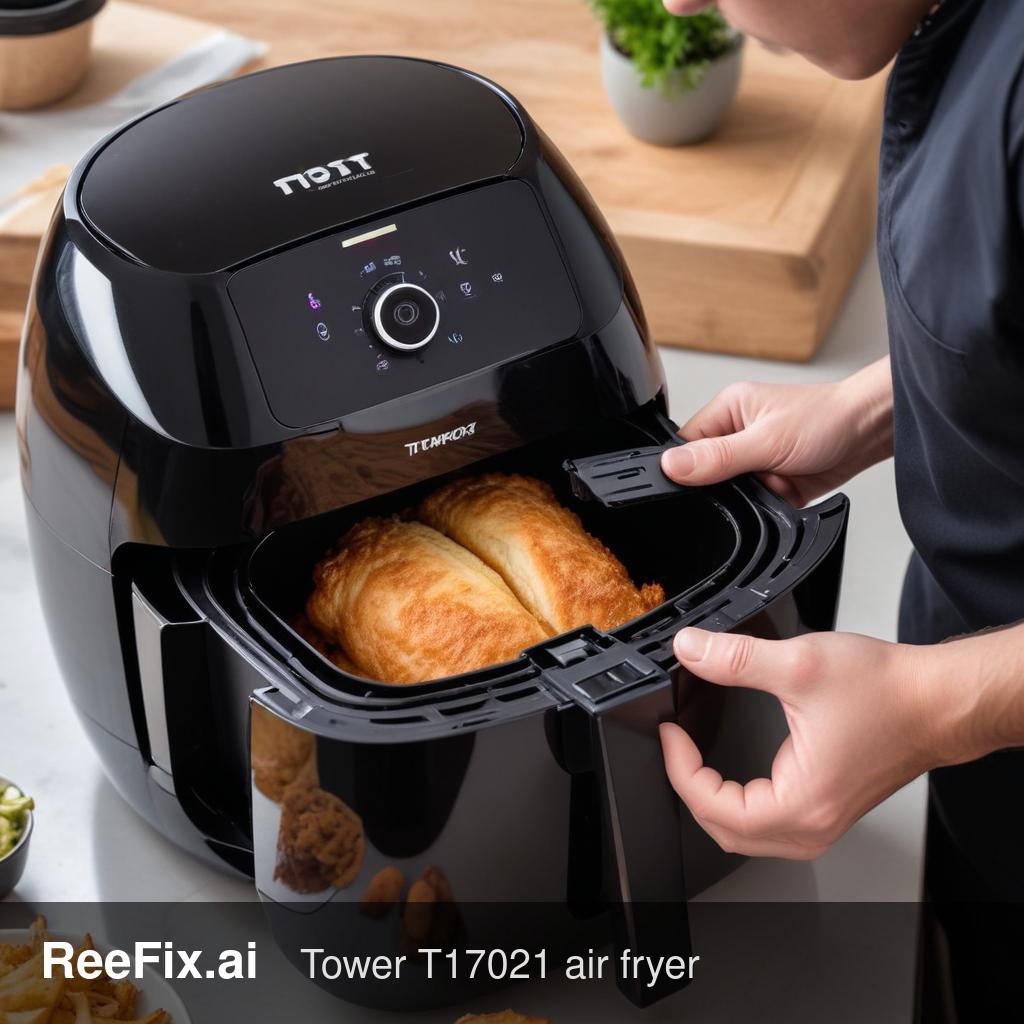
Tower T17021 Air Fryer Drawer Not Closing - Repair Guide
Validated by Luca Chia, Certified Electronic Technician
Revision of 16/06/2026
SAFETY WARNING. This appliance is connected to the 230V mains electricity. It is mandatory to always unplug it from the socket before any inspection or disassembly. If the physical or electrical intervention is complex, it is recommended to rely on a qualified technician for your safety. ReeFix provides this diagnosis EXCLUSIVELY for educational and informational purposes.
TECHNICAL CHECKLIST
- Visual Inspection of Latch/Hook: Check the closing hook on the drawer and the latching mechanism in the air fryer body. Look for cracks, breaks, wear, or plastic deformations.
- Mechanism Spring Check: Ensure that the internal spring of the closing mechanism (if visible) has the correct tension and is not dislocated or broken. It must push the hook into the locked position.
- Microswitch Test: With a multimeter, check the continuity of the safety microswitch (interlock) when the drawer is fully closed. It must click mechanically and close the circuit.
- Drawer Alignment: Assess whether the drawer slides freely and aligns perfectly with the opening. Look for excessive play or abnormal friction on the side rails.
- Presence of Obstructions: Check the area of the closing mechanism and the drawer rails for food residues, hardened grease, or foreign objects that may block movement at the end of its travel.
- Gasket Condition: Inspect the drawer's rubber gasket for damage, deformation, or incorrect positioning that could create thickness and prevent complete closure.
- Structural Integrity: Examine the plastic housing of the air fryer and the drawer around the latch area for any cracks or structural deformations due to heat.
INSPECTION RESULT
1. Mechanical Failure of Closing Components (e.g., broken plastic tab, weakened spring) - 60% probability
- Key signs: The drawer does not lock at all, "wobbles" or slides back slightly on its own. Visible breaks or signs of heavy wear on the drawer hook or the latch in the appliance body. The internal spring offers no resistance.
- Why: Repeated use and high temperatures can weaken the plastic or fatigue the spring, causing breakage or loss of tension in the essential latching components. This often happens when the drawer is closed with too much force or slammed.
- Quick checks:
- Remove the drawer and carefully inspect the hook on the basket and the latching mechanism inside the air fryer body.
- If you have visual access, try to manually move the tab or hook to test the tension of the return spring.
- Estimated DIY repair cost: 15-30€ for a Tower T17021 Air Fryer Drawer Latch Mechanism. Replacement requires partial disassembly of the front plastics.
- Tools needed: Precision screwdrivers, plastic pry tools (spudger).
2. Faulty or Misaligned Safety Microswitch - 25% probability
- Key signs: The drawer seems to close mechanically and lock into place, but the air fryer does not start (the fan and heating element do not turn on). You don't hear the classic mechanical "click" of the microswitch when you push the drawer all the way in.
- Why: Even if the physical closing mechanism works, if the internal microswitch is not pressed correctly, the main electrical circuit will not close. Being a manual model, this switch directly cuts off power to prevent operation with the drawer open. A typical defect is the microswitch shifting from its seat or oxidation of the internal contacts.
- Quick checks:
- With the air fryer strictly unplugged from the socket, locate the microswitch (usually positioned at the end of the sliding rail or near the latching mechanism).
- Manually press the small pin of the microswitch to feel if it clicks and to assess its mechanical resistance.
- Using a multimeter, test the continuity on the microswitch's terminals in both open and pressed positions.
- Estimated DIY repair cost: 5-15€ for a replacement microswitch for air fryer. Replacement requires a minimum of manual skill to disconnect and reconnect the electrical terminals.
- Tools needed: Multimeter, screwdrivers, long-nose pliers.
3. Drawer/Housing Misalignment or Obstructions - 10% probability
- Key signs: The drawer closes with difficulty, "scratches" along the sides, does not go all the way in, or leaves visible gaps. The presence of food residues or carbonized grease around the rails or mechanism is evident.
- Why: Even a small solid obstruction or a slight misalignment of the rails prevents the drawer from reaching the exact final position. This prevents the closing mechanism from engaging the latch or the microswitch from being pressed sufficiently.
- Quick checks:
- Thoroughly clean the drawer's sliding rails and the closing mechanism area of any grease or food residues.
- Visually check if the metal basket is bent or if the plastic housing has suffered heat deformations.
- Estimated DIY repair cost: 0-5€ (deep cleaning, manual repositioning).
- Tools needed: Microfiber cloth, stiff-bristle brush, degreaser.
Technician output (synthetic handoff): The Tower T17021 device (manual model) presents an operational blockage due to the non-recognition of the drawer closure. The symptom indicates a problem in the mechanical retention system or the safety microswitch (interlock). The most probable causes are the breakage of the plastic components of the drawer latch or the malfunction/misalignment of the microswitch that does not close the power circuit. A thorough visual inspection of the latching mechanism and a continuity test of the microswitch with a multimeter are recommended. Also, check the general alignment of the rails and the absence of obstructions from carbonized grease.
Operational decision: If the drawer does not physically lock or the hook is visibly broken (Cause 1) -> Consider replacing the closing mechanism if you have good DIY skills. If the drawer locks correctly but the machine does not start (Cause 2) -> Check the microswitch with a multimeter; if it does not show continuity, replace it. If the problem is mechanical friction or incomplete closure (Cause 3) -> Perform a deep cleaning of the rails and realign the basket. If the damage is structural (heat-deformed plastics) or the repair is complex and costly (>30-40€) -> Contact a technician or consider replacing the entire device, considering that the cost of a new Tower T17021 is around 80-150€.
Why won't my Tower T17021 Air Fryer drawer close properly?
Common causes include damaged latch/hook, faulty microswitch, spring issues, drawer misalignment, or obstructions like food debris. Inspect these areas.
How can I diagnose why my air fryer drawer isn't latching?
Check for visible damage to the latch, test the microswitch continuity, look for obstructions, or assess drawer alignment and gasket condition.
When should I call a technician for an air fryer drawer not closing?
If visual inspection or basic checks don't identify the issue, or if complex electrical/mechanical intervention is needed, consult a qualified technician.
This diagnostic report is generated using an artificial intelligence system (RAG) based on the aggregation of online data. The moderation by Luca Chia (Electronic Expert) validates its logical coherence and technical plausibility regarding the described symptoms, confirming the correctness of the AI's diagnostic reasoning, without however constituting an absolute guarantee of resolution for individual cases.