
DJI Air 3S: Gimbal Calibration Block Due to Motor Failure - Diagnosis
Generated by ReeFix AI · Sources: technical and specialist documentation (see Sources section)
Revision of 07/07/2026
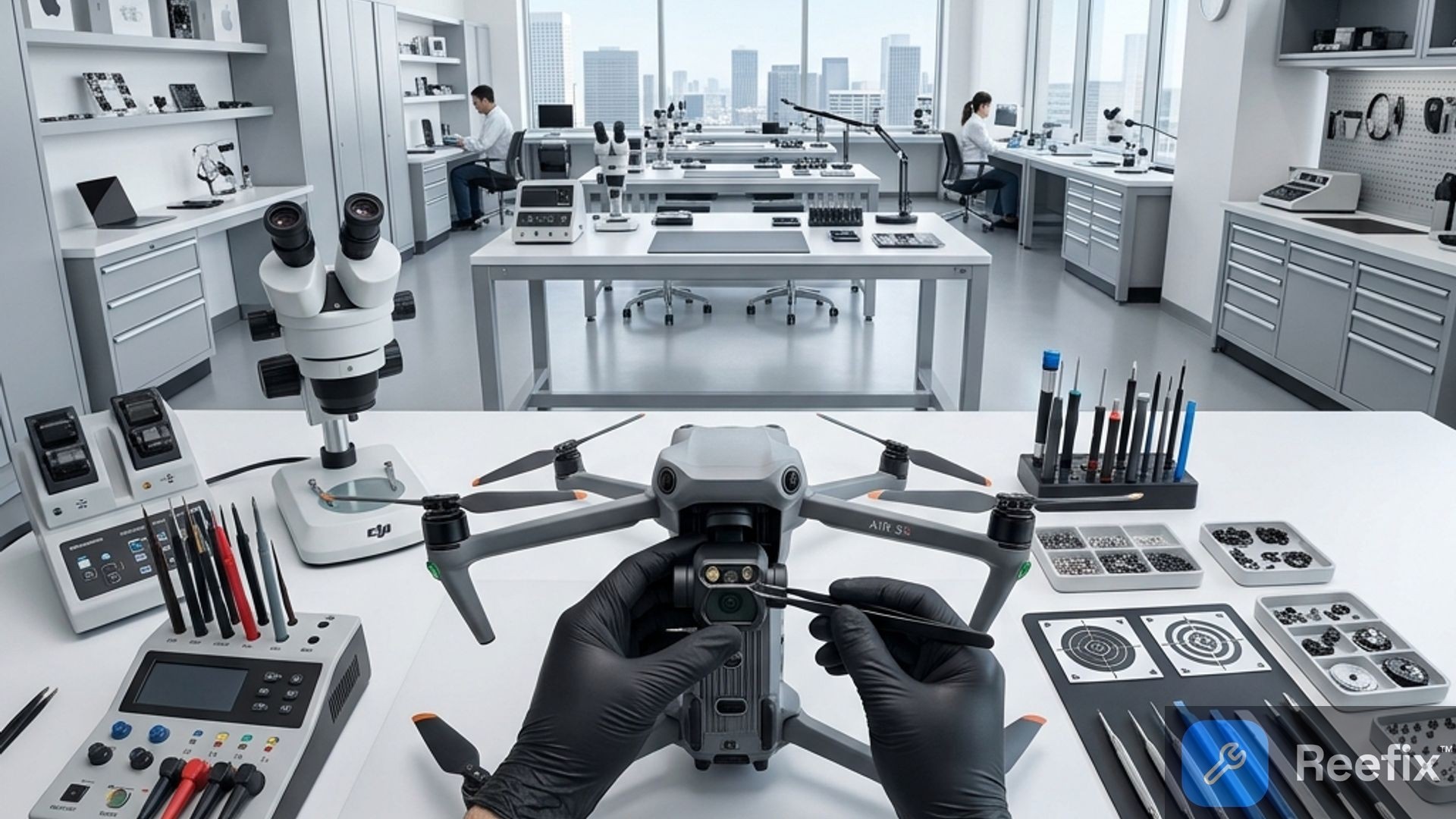
⚠️ SAFETY WARNING / FIRE RISK. This device contains lithium batteries. Improper puncturing or bending during disassembly can cause explosions or flames. The intervention requires precision and the assistance of a specialized technician is recommended. ReeFix provides this diagnosis EXCLUSIVELY for educational and informational purposes.
QUICK TEST
To quickly assess the nature of the calibration block on the pitch axis of your DJI Air 3S, follow these steps:
- Observation at startup: Turn on the drone. Does the gimbal attempt calibration?
- Yes, it tries but fails: The gimbal moves, perhaps vibrates for a few seconds, then "gives up" (loses strength) or gets stuck in an abnormal position. The DJI Fly app shows a failed calibration error or "gimbal motor overloaded".
- No, it remains still: The gimbal shows no sign of life on the pitch axis from startup, remaining "limp".
- Manual movement (with drone off): With the drone off and the battery removed, try to gently move the camera's pitch axis (up and down).
- Smooth movement: The axis moves freely and smoothly. You don't feel any abnormal friction or "clicks".
- Blocked/irregular movement: The axis is hard to move, gets stuck at some points, or you feel resistance and "grinding".
DECISION FORK
Based on the quick test results, here's how to proceed:
- If the gimbal attempts calibration but fails (point 1 "Yes") AND manual movement is smooth (point 2 "Smooth movement"):
- High probability (60-75%) of DJI Air 3S Flexible Flat Cable failure. This is the most common failure. The cable, subjected to continuous flexing, develops micro-interruptions that prevent the motor from receiving commands or sending position feedback. * Repair yourself: Possible if you have good manual skills and precision tools (small screwdrivers, tweezers). The replacement part costs about 15-30€. There are online tutorials, but the process is delicate. * Contact a technician: Recommended if you have no experience. Estimated cost (part + labor): 70-120€.
- If the gimbal remains still (point 1 "No") AND manual movement is smooth (point 2 "Smooth movement"):
- Medium probability (20-30%) of pitch motor or its driver board failure. Less likely than the cable, but possible. There could be an internal interruption in the motor windings or a problem with the control driver on the gimbal's logic board. * Repair yourself: Very difficult and not recommended. Requires fine soldering and advanced diagnostic capabilities (multimeter to test windings). The replacement motor costs about 40-80€. * Contact a technician: Strongly recommended. Estimated cost (motor replacement + labor): 120-180€.
- If manual movement is blocked/irregular (point 2 "Blocked/irregular movement"), regardless of startup behavior:
- High probability (70-85%) of mechanical damage or wear of the pitch motor bearings. Even a slight impact or the ingress of dirt/sand can deform the motor shaft or damage the bearings. The motor tries to move but encounters resistance; the system detects this as an overload and blocks everything. * Repair yourself: Extremely difficult. Requires complete disassembly of the motor/gimbal assembly and often replacement of internal mechanical components or the motor itself. * Contact a technician: Indispensable. The technician will assess whether to replace only the motor (if the damage is limited) or the entire DJI Air 3S Gimbal. Estimated cost for motor replacement: 120-180€. For complete gimbal replacement: 250-400€ (part + labor). * Replace the device: If the cost of repairing the complete gimbal approaches or exceeds 400-500€, consider purchasing a new DJI Air 3S (cost starting from about 1000€), especially if the drone has suffered other serious structural damages.
DIAGNOSIS CONFIRMED
The gimbal calibration block on the pitch axis of the DJI Air 3S is almost always related to a hardware problem, with the flexible flat cable (ribbon cable) as the main suspect.
Causes and Probabilities:
- Breakage or wear of the DJI Air 3S Flexible Flat Cable (55%):
- Why: This cable handles power and data for the pitch motor. Continuous flexing and twisting during flight and calibration can cause micro-fractures in the conductive traces. The motor receives intermittent power or incorrect data from the position sensor, failing to maintain torque or report its position to the controller.
Very often, this damage also manifests with an annoying black screen on the flight app: if you receive telemetry but have no live video feed, the flat cable is almost certainly interrupted and needs to be replaced.
- Key signs: Gimbal "drooping", brief vibrations at startup, calibration block at a fixed percentage (e.g., 10-20%), motor appears free manually.
- Often happens when: The drone has many flight hours, has been stored without gimbal protection, or has suffered minor non-obvious mechanical stress.
- Mechanical damage to the axis or motor bearings (30-35%):
- Why: An impact, even if not severe, can deform the motor shaft or gimbal arms, creating friction. The ingress of dust or sand can also damage the ball bearings. The motor tries to move but encounters excessive resistance; the system interprets this as an overload and shuts down for protection.
- Key signs: The pitch axis is stiff, "jerky", or blocked if moved manually with the drone off. The gimbal may attempt calibration but immediately blocks.
- Typical user error: Not storing the drone with the gimbal protector installed, exposing the joint to accidental impacts.
- Internal failure of the pitch motor or driver board (10-15%):
- Why: Less frequent, but possible. A short circuit or an interruption in the brushless motor windings, or a failure of the driver chip (ESC) on the gimbal's logic board, prevents the motor from functioning correctly.
- Key signs: Gimbal completely inert on the pitch axis, even if manual movement is smooth.
- Limit condition: Prolonged overloads or overheating can damage the windings or control electronics.
Output for technician: "The DJI Air 3S exhibits a systematic block of the gimbal calibration procedure, attributable to an anomaly on the pitch axis. At startup, the gimbal partially performs the self-test but fails to complete the vertical excursion, showing signs of high-frequency vibration or total absence of motor torque on the tilt axis, followed by motor release (limp gimbal). The DJI Fly application returns failed calibration or gimbal motor overload errors. It is required to perform an electrical continuity analysis on the DJI Air 3S Flexible Flat Cable, paying particular attention to sections subjected to torsion. Verify the mechanical integrity of the motor shaft, the absence of parasitic friction in the ball bearings, and the correct impedance of the stator windings of the brushless pitch motor. In case of replacement, perform advanced software calibration of the IMU parameters."
Tools for a technician: A technician will use a precision Digital Multimeter for continuity and resistance tests, Torx precision screwdrivers for disassembly, and, in complex cases, a Precision Soldering Station for micro-soldering.
Operational decision: If the manual movement of the axis is smooth and the gimbal attempts calibration, the most probable cause is the flexible cable (replacement part 15-30€), repairable by oneself with caution or by a technician (70-120€); if the movement is blocked or irregular, it is mechanical damage that requires a technician, with costs that can reach 250-400€ for a complete DJI Air 3S Gimbal.
Why does the DJI Air 3S have a gimbal calibration lock due to motor failure?
The DJI Air 3S gimbal calibration lock is often due to a pitch motor failure or a worn flexible flat cable.
How to diagnose a drone gimbal motor failure?
Check if the gimbal moves on startup. With the drone off, check if the pitch axis moves smoothly or if it is blocked.
When is a technician needed for gimbal calibration lock?
It is necessary if the axis is mechanically blocked, if the motor is off, or if the complete gimbal needs to be replaced with software calibration.
This diagnostic report is generated using an artificial intelligence system (RAG) based on the aggregation of online data. No publication happens automatically: the rigorous multi-step moderation by Luca Chia (Electronic Expert) validates its logical coherence and technical plausibility regarding the described symptoms, confirming the correctness of the AI's diagnostic reasoning, without however constituting an absolute guarantee of resolution for individual cases.