
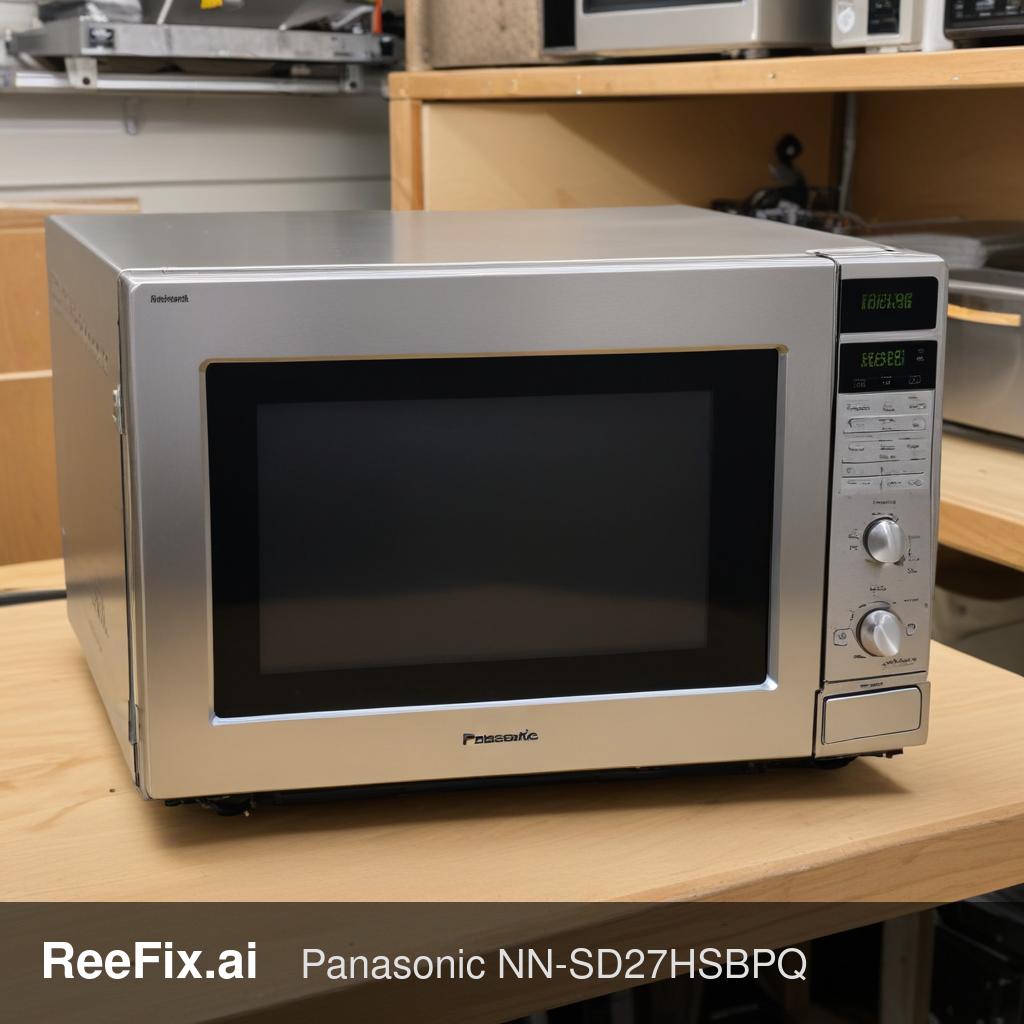
Panasonic NN-SD27HSBPQ: Door locked and latch broken - Solution
Generated by ReeFix AI · Sources: technical and specialist documentation (see Sources section)
Revision of 27/06/2026
⚠️ SAFETY WARNING / SERIOUS RISK. This appliance operates with critically dangerous components (High Voltage). DIY repair of critical devices can be fatal and is prohibited by law. Physical intervention legally requires qualified specialized technicians to issue compliant safety certificates. Before any external inspection, disconnect the appliance from the electrical supply via the general circuit breaker or by removing the plug. ReeFix provides this diagnosis EXCLUSIVELY for educational and informational purposes.
QUICK TEST: Locked Door Diagnosis
For a quick diagnosis of your Panasonic NN-SD27HSBPQ with a locked door and broken latch, follow this checklist:
-
1. Test the open button: Press the door open button.
- Result A: The button feels loose, "springy" or offers no resistance.
- Interpretation: Strong sign of physical breakage of the closing latch or complete detachment of the spring. Most common cause.
- Result B: The button offers resistance but the door does not open.
- Interpretation: There might be a less severe mechanical blockage or misalignment.
- Result A: The button feels loose, "springy" or offers no resistance.
-
2. Check door movement (after pressing the button): Apply very light pressure or pull on the door.
- Result A: The door remains immobile and tight.
- Interpretation: Confirms a rigid mechanical blockage.
- Result B: You feel a slight play but the door does not open.
- Interpretation: There might be minor deformation or misalignment, but the mechanism is still compromised.
- Result A: The door remains immobile and tight.
DECISION FORK
Within 60 seconds, here's how to decide your next move:
- Repair it yourself? NO (Highly discouraged and prohibited by law).
- Accessing the internal mechanism of a microwave door is extremely complex and dangerous. It requires disassembling critical parts that ensure microwave shielding. Any error can make the appliance hazardous to health due to radiation leakage. Furthermore, high-voltage components are present inside the microwave (the capacitor can retain a lethal charge even when unplugged). The law mandates that only qualified technicians work on these devices.
- Contact a specialized technician? YES (Safest and recommended option).
- The probability is high that it is a problem solvable by replacing a relatively inexpensive spare part (latch or spring). A technician will know how to intervene safely, unlock the door without damaging the shielding, replace the component, and, most importantly, perform the necessary safety tests (e.g., RF leakage check) after the repair.
- Replace the device? EVALUATE.
- If your Panasonic NN-SD27HSBPQ is an older model, the cost of the technician's labor (which adds to the cost of the spare part) might approach or exceed the price of a new entry-level microwave. Get a quote and compare it with the cost of a new appliance (approximately €100-200). If the repair cost exceeds 60-70% of the value of a new microwave, replacement is often the most rational choice.
DIAGNOSIS CONFIRMED
Based on quick tests and technical analysis, the most probable diagnosis is an internal mechanical fault in the door.
Cause 1: Physical breakage of the door latch - Probability: 65-70%
- Why: The plastic latch, subjected to repeated opening/closing cycles and exposure to heat and cooking vapors, tends to crystallize and break. This prevents proper engagement/disengagement from the frame slots. The external button, no longer finding the contact point, feels loose.
- Key signs: Open button completely free, without resistance or "click." The door is rigidly locked.
- Estimated cost (technician): The spare part Panasonic NN-SD27HSBPQ Door Latch costs approximately €10-25. Specialized labor for disassembly, replacement, and safety tests is estimated between €60-120. Total cost: €70-145.
- Often happens when: The microwave is over 3-5 years old or used very frequently. A typical user error is attempting to force the door open with objects, aggravating the damage.
Cause 2: Detachment or breakage of the latch return spring - Probability: 15-20%
- Why: The small metal spring that provides tension and returns the latch to position can detach from its seat or break due to material fatigue. Without this tension, the latch does not move correctly.
- Key signs: The open button is very soft, and sometimes a slight rattling sound of a loose metallic component can be heard inside the door.
- Estimated cost (technician): The spare part Panasonic NN-SD27HSBPQ Door Latch Spring costs approximately €5-15. Labor is similar to latch replacement. Total cost: €65-135.
Output for technician (Synthetic Handoff): "Panasonic NN-SD27HSBPQ oven with locked door. Open button inactive, probable latch/spring breakage. Manual door unlock required (after capacitor discharge), inspection and replacement of latch/spring. Verify alignment and functionality of Panasonic NN-SD27HSBPQ Door Microswitch and RF leakage test post-repair."
Safety notes:
- NEVER attempt to force the door with tools: This risks damaging the internal shielding mesh, making the appliance hazardous to health and irreparable.
- Mechanical risk of hinges: If working on the door, pay extreme attention to the sudden snap of the hinge springs, which can cause serious injuries or crushed fingers.
- High voltage hazards: A microwave contains a capacitor that can store thousands of volts even after being unplugged. Only professionals with a High Voltage Capacitor Discharger and Professional Digital Multimeter should intervene.
Final operational decision: The most probable cause by far (65-70%) is the physical breakage of the door latch. As this intervention requires disassembling the door and restoring the anti-radiation shielding, the main recommendation is to contact a specialized technician for the replacement of the latch or spring. However, since the estimated total cost of the intervention (€65-145) can approach the market value of a new microwave, carefully evaluate replacing the appliance if the quote exceeds 60-70% of its value.
Why is my Panasonic NN-SD27HSBPQ microwave door locked and latch broken?
Common causes include physical breakage of the latch mechanism, a detached spring, or internal mechanical blockage. The door button feeling loose often indicates a broken latch.
How can I diagnose a locked microwave door and broken latch?
Test the door open button for looseness or lack of resistance. Check for any door movement after pressing the button. A rigid, immobile door confirms a mechanical blockage.
When should I call a technician for a locked microwave door?
Immediately. Microwaves contain high-voltage components. DIY repair is dangerous and illegal. A qualified technician is required for safe diagnosis and repair.
This diagnostic report is generated using an artificial intelligence system (RAG) based on the aggregation of online data. The moderation by Luca Chia (Electronic Expert) validates its logical coherence and technical plausibility regarding the described symptoms, confirming the correctness of the AI's diagnostic reasoning, without however constituting an absolute guarantee of resolution for individual cases.