
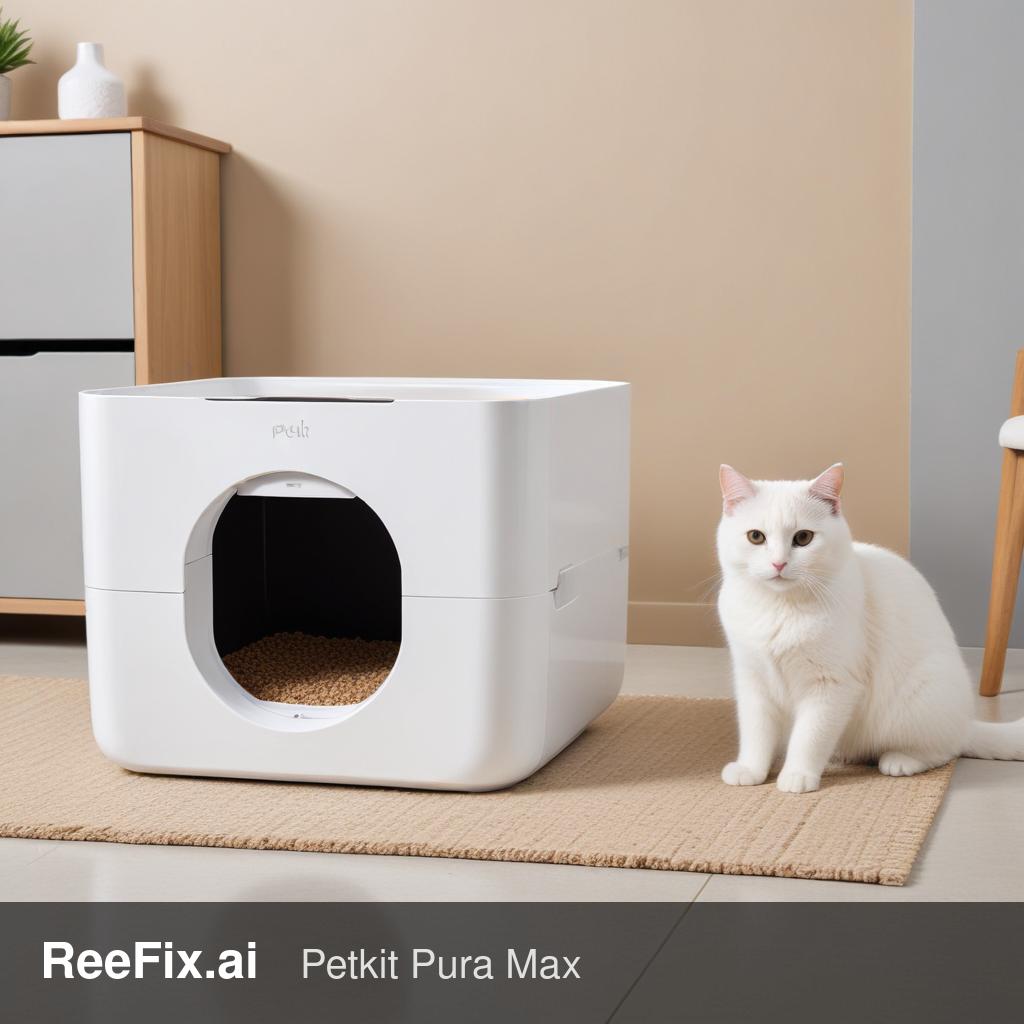
Petkit Pura Max: cylinder stuck and motor straining - Diagnosis
Generated by ReeFix AI · Sources: technical and specialist documentation (see Sources section)
Revision of 25/06/2026
⚠️ SAFETY WARNING. This appliance is powered by low voltage (12V DC) via an external power supply connected to the mains. It is essential to unplug the power supply from the wall socket before any intervention or disassembly to avoid short circuits or irreversible damage to the electronic board. If physical intervention proves complex, it is recommended to rely on a qualified technician. ReeFix provides this diagnosis EXCLUSIVELY for educational and informational purposes.
QUICK TEST
To quickly identify the cause of the cylinder blockage and motor strain on your Petkit Pura Max, follow these steps in sequence.
- Visual and manual inspection (DEVICE UNPLUGGED):
- Remove the drum: With the device unplugged, remove the main litter drum.
- Check for obstructions: Inspect the inside of the compartment where the drum rotates. Look for accumulations of solidified litter, hair, or foreign objects that could block rotation.
- Check support rollers: Check the rollers located at the base of the compartment. They must rotate freely and not show encrusted dirt or deformations. Thoroughly clean their surface and the sliding tracks with a damp cloth and, if necessary, some Isopropyl alcohol spray on eBay.
- Check gears: Observe the toothed ring gear on the edge of the drum and the motor reducer's pinion (the small toothed wheel that meshes with the drum). They must be clean and intact.
- Manual motor test: With the drum removed, try to manually turn the motor pinion (if accessible without disassembly). It should move with some resistance, but without obvious blockages or grinding noises.
- Power supply test (requires multimeter):
- If you have a Professional Digital Multimeter on eBay, measure the output voltage from the wall power supply (typically 12V DC).
- Perform the measurement both unloaded (only power supply connected to the multimeter) and, if possible, by simulating the start of the cycle with the multimeter connected in parallel to the device input. The voltage should not drop significantly below 11.5V during motor startup.
DECISION FORK
Based on the quick test results, choose your path:
- If cleaning rollers, guides, and gears solves the problem: You can repair it yourself. The cause was simple mechanical friction or an obstruction.
- If the power supply shows significant voltage drops under load: You can repair it yourself by purchasing and replacing the external plug-and-play power supply.
- If the motor does not turn freely by hand (even without the drum) or makes abnormal grinding noises: An internal fault in the gear motor is likely. I recommend contacting a technician.
- If you have cleaned everything, the power supply seems stable, and the motor turns freely, but the problem persists: This could be a complex electronic fault or an issue with the positioning sensors (Hall sensors or oxidized magnets). In this case, consider whether to contact a technician for an in-depth diagnosis or consider replacing the device, as the repair costs for the logic board can be high.
CONFIRMED DIAGNOSIS
Here are the most probable causes in descending order, with indications for decision-making:
- Mechanical friction or obstruction (Probability: 65%)
- Key signs: The cylinder gets stuck at specific points, sometimes with scraping noises. The problem can be intermittent.
- Why it often happens: Litter dust, especially fine bentonite, accumulates on rollers, guides, and gears, acting as a brake. This increases the effort required by the motor, which draws too much current and is blocked by the protection system.
- Recommended action: Repair it yourself. Thoroughly clean all mechanical parts (rollers, guides, drum ring gear, motor pinion) with Isopropyl alcohol spray on eBay. Lubricate the roller pins and, sparingly, the gears with Silicone lubricant grease on eBay.
- Estimated cost: Low (€5-15 for cleaning/lubrication materials).
- Wear or damage to the gear motor assembly (Probability: 20%)
- Key signs: The motor makes noise but cannot move the drum, or it rotates in jerks even without load. The motor pinion may appear blocked or have excessive play.
- Why: The internal gears of the motor's reduction gearbox, often plastic, can chip or wear out under continuous stress or due to abrasive dust ingress. A single damaged tooth can block the entire mechanism.
- Recommended action: Contact a technician. Replacing the Petkit Pura Max replacement motor on eBay is the only solution, an operation that requires advanced disassembly of the internal casing.
- Estimated cost: Medium-High (€40-80 for the spare part, plus technician labor).
- Defective external power supply (Probability: 10%)
- Key signs: The device blocks at the start of the cycle, the voltage measured from the power supply drops below 11.5V during startup.
- Why: Over time, the internal capacitors of the power supply can degrade, preventing it from providing the peak current needed by the motor during startup. This simulates a mechanical blockage for the motherboard.
- Recommended action: Repair it yourself. If the multimeter test confirms the voltage drop, replace the power supply with a new 12V Petkit Pura Max power supply on eBay.
- Estimated cost: Low-Medium (€20-40 for the spare part).
- Electronic or sensor fault (Probability: 5%)
- Key signs: No mechanical or power supply problems detected, but the device continues to report motor blockage.
- Why: A malfunction in the current sensing circuit on the motherboard can cause a false overload reading. Alternatively, the Hall sensors that monitor drum position or the magnets on the drum itself (which tend to oxidize or detach if washed with water) may be defective, preventing the system from confirming correct rotation.
- Recommended action: Contact a technician or replace the device. Diagnosis and repair of these components require specialized equipment and skills. Often, the cost of repairing the logic board or replacing the sensors can be uneconomical compared to purchasing a new Petkit Pura Max.
- Estimated cost: High (€80+ for logic board, plus labor).
Output for technician (synthetic handoff): "The Petkit Pura Max reports motor blockage/strain. Verify the integrity of the 12V DC gear motor assembly (gear wear, current draw no-load/load), 12V power supply voltage stability during startup. Inspect rollers and guides for friction/deposits, clean and lubricate. Check magnets and Hall sensors for rotation feedback."
Typical user error: Not performing regular thorough cleaning of the motor compartment and drum guides. Accumulation of litter dust is the most common cause of these blockages.
If cleaning solves the problem or if the external power supply needs to be replaced, you can proceed independently. If the motor is faulty, contact a technician for component replacement; if the fault concerns the electronic board or internal sensors, consider replacing the device.
Why is my Petkit Pura Max cylinder stuck and motor straining?
Common causes include solidified litter, hair, foreign objects obstructing rotation, dirty/damaged support rollers, or issues with the drum/motor gears. A quick visual inspection can help identify the
How can I diagnose a stuck cylinder on an automatic litter box?
Unplug the device, remove the drum, and visually inspect for obstructions, check support roller freedom, and examine the condition of the drum and motor gears for cleanliness and integrity.
When should I call a technician for a Petkit Pura Max cylinder blockage?
If visual inspection and basic cleaning don't resolve the issue, or if you suspect internal component damage (e.g., motor, electronics), it's best to consult a qualified technician to avoid further da
This diagnostic report is generated using an artificial intelligence system (RAG) based on the aggregation of online data. The moderation by Luca Chia (Electronic Expert) validates its logical coherence and technical plausibility regarding the described symptoms, confirming the correctness of the AI's diagnostic reasoning, without however constituting an absolute guarantee of resolution for individual cases.